By most reckonings Maharashtra holds five of the twelve Jyotirlingas. This guide covers the three we have researched in depth: Trimbakeshwar in Nashik district, Grishneshwar at Verul near the Ellora caves, and Bhimashankar in the hills of Pune district. The other two, Aundha Nagnath and Parli Vaijnath in Marathwada, are real and much loved, but we have not yet verified their timings and routes, so they appear here as an honest gap rather than as guesses.
The three temples form a rough triangle across the state. Trimbakeshwar sits approx 28 km west of Nashik at the foot of Brahmagiri hill, where the Godavari rises. Grishneshwar is roughly 30 km from Chhatrapati Sambhajinagar, formerly Aurangabad, and about a kilometre and a half from the Ellora caves. Bhimashankar is the outlier, roughly 110 to 125 km from Pune at the end of a slow ghat road inside a wildlife sanctuary. No leg between any two temples is short, which is why the order you travel them in matters more here than on most pilgrimages.
Below you will find the circuit at a glance, a suggested loop from Mumbai or Pune, the leg-by-leg distances, and the two things that wreck more itineraries than traffic does: midday sanctum closures and, at Bhimashankar, a construction restriction that has repeatedly shortened darshan hours. Festival windows, dress rules and stay options follow.
The three temples at a glance
Each temple has a full page on this site with timings, aarti schedules and transport detail, so this guide stays at circuit level: what each stop is, where it sits, and the one fact about it that shapes your plan. At Trimbakeshwar that fact is ritual. It is the country's most sought-after temple for Kaal Sarp, Narayan Nagbali and Tripindi ceremonies, and its linga is unlike any other, three small natural faces worshipped as Brahma, Vishnu and Shiva together. At Grishneshwar the fact is position: the twelfth and last of the twelve Jyotirlingas, standing close enough to the Ellora caves that the two share a visiting crowd. At Bhimashankar the fact is terrain: the sixth Jyotirlinga is the only one inside a wildlife sanctuary, at approx 3,250 ft in the Sahyadri range, and the final stretch from the car park is climbed on foot up a flight of steps.
| Temple | Where it sits | Darshan hours | Nearest railhead |
|---|---|---|---|
| Trimbakeshwar | Trimbak town, approx 28 km west of Nashik | Daily approx 5:30 AM to 9:00 PM | Nashik Road, approx 39 km |
| Grishneshwar | Verul village, approx 30 km from Chhatrapati Sambhajinagar | 5:30 AM to 9:30 PM, with a long midday break | Chhatrapati Sambhajinagar (AWB), approx 30 km |
| Bhimashankar | Bhorgiri hills, approx 110 to 125 km from Pune | Official 5:00 AM to 9:30 PM; currently often restricted | Pune Junction, approx 111 km |
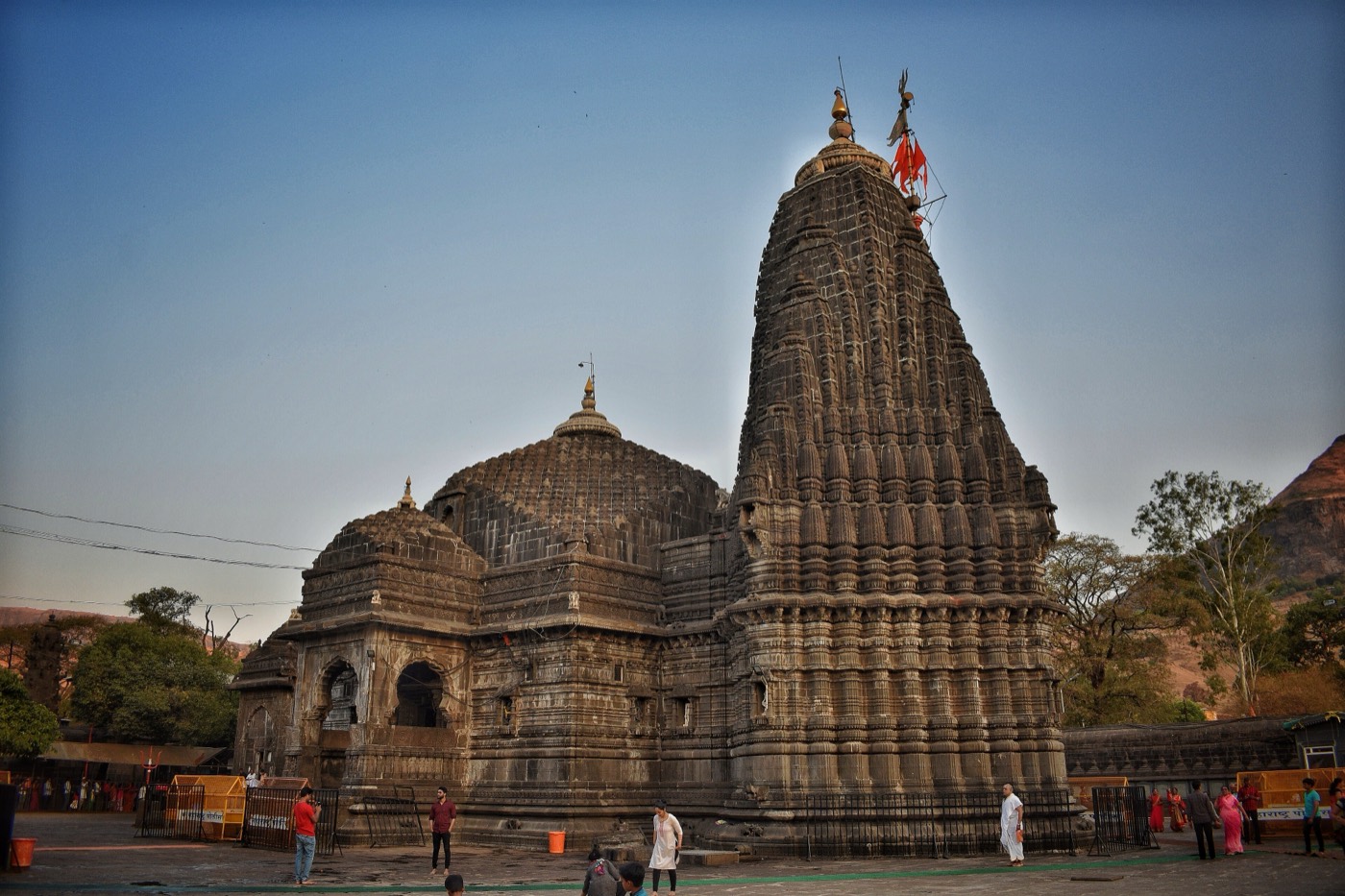
Trimbakeshwar Jyotirlinga Temple
Nashik, Maharashtra

Grishneshwar Jyotirlinga Temple
Chhatrapati Sambhajinagar (Aurangabad), Maharashtra
Bhimashankar Jyotirlinga
Pune, Maharashtra
A workable loop from Mumbai or Pune
Starting from Mumbai, the natural order is Nashik first. Trimbakeshwar is approx 180 km from Mumbai's international airport, a 4 to 5 hour drive, and Nashik city makes an easy base approx 28 km from the temple. Take darshan early, walk to the Kushavarta kund where the Godavari first surfaces, and move on.
The second leg runs east to Verul for Grishneshwar. Our per-temple research puts this leg at approx 180 to 210 km depending on the source and route, which in practice is most of a day once you add stops. Sleeping in Chhatrapati Sambhajinagar, roughly 30 km from the temple, gives you the widest choice of hotels and puts the Ellora caves on your doorstep for the temple's long midday closure.
The third leg is the big one: approx 280 to 300 km from Grishneshwar to Bhimashankar, ending in slow ghat driving that is best done in daylight. From Bhimashankar it is approx 110 to 125 km down to Pune, which is why many travellers run the whole loop in reverse: Pune up to Bhimashankar, across to Grishneshwar and Ellora, then Trimbakeshwar, and finally the 4 to 5 hour run back to Mumbai. Both directions work. Pick the one that puts your hardest driving on your freshest day.
Leg by leg: road distances
Distances between the three temples vary noticeably between sources, partly because more than one road route exists for each leg. The figures below carry the ranges exactly as our per-temple research recorded them, and every one is approximate. Treat them as planning numbers rather than navigation, and expect the ghat sections near Bhimashankar to run much slower than the kilometre count suggests.
| Leg | Distance | Note |
|---|---|---|
| Mumbai (airport) to Trimbakeshwar | approx 180 km | A 4 to 5 hour drive via Nashik |
| Nashik city to Trimbakeshwar | approx 28 km | Around 45 to 60 minutes by state bus or taxi |
| Trimbakeshwar to Grishneshwar | approx 180 to 210 km | Sources differ; most of a day with stops |
| Grishneshwar to Bhimashankar | approx 280 to 300 km | The longest leg; ends in ghat roads |
| Bhimashankar to Pune | approx 110 to 125 km | Roughly 3.5 to 4 hours on ghat roads |
| Detour: Trimbakeshwar to Shirdi | approx 90 km | Shirdi is approx 130 km from Grishneshwar |
Darshan windows and midday breaks
On paper all three temples keep long hours. In practice the middle of the day belongs to the priests, and each temple handles that differently. Grishneshwar is the strictest: public darshan runs approx 5:30 AM to 12 noon, the sanctum then closes for the noon puja and Maha Prasad, and darshan resumes from 4:00 PM to 9:00 PM. Arrive in the early afternoon and you will simply wait.
Bhimashankar needs the most care. The official schedule runs 5:00 AM to 9:30 PM, with morning darshan and abhishek from 5:30 AM to 12:00 PM, a naivedya break around noon, and worship blocks at 2:45 to 3:20 PM and 7:30 to 8:00 PM. However, an active restoration of the sabhamandap and steps has repeatedly cut darshan to roughly 7:00 AM to 11:00 AM. The drive up is long, so phone ahead the day before you travel. That single call protects the whole circuit.
Trimbakeshwar is the most forgiving. Public darshan from the sabha mandap runs approx 5:30 AM to 9:00 PM, with only brief sanctum closures during the fixed daily pujas. Mondays bring the heaviest crowds and, at approx 4:30 PM, the palkhi procession in which the temple's jewelled crown, said to date to the Pandava era, is taken out. That is worth planning around rather than away from.
| Temple | Midday pattern | Inner sanctum rule |
|---|---|---|
| Trimbakeshwar | Open through the day; brief closures during fixed pujas | Men in a sovala or silk dhoti for hands-on abhishek; women and most visitors take darshan from the outer hall |
| Grishneshwar | Sanctum closed from about 12 noon to 4:00 PM | Men must remove shirt, vest and belt; strictly enforced |
| Bhimashankar | Naivedya break around noon; worship blocks 2:45 to 3:20 PM and 7:30 to 8:00 PM | Dhoti or bare-chested for abhishek, as the priests direct |
What to wear and what to leave in the car
The dress standard across the circuit is the same in spirit: modest, traditional clothing, with shorts, sleeveless tops and short skirts discouraged everywhere. The differences appear at the sanctum door, and they are worth knowing before you join a queue.
- At Grishneshwar, men entering the garbhagriha must remove shirt, vest and belt, and the rule is strictly enforced.
- At Trimbakeshwar, hands-on abhishek in the inner sanctum traditionally requires men to wear a sovala or silk dhoti with no stitched upper garment; women and most visitors take darshan from the outer hall.
- At Bhimashankar, men often perform abhishek in a dhoti or bare-chested, following the priests' guidance.
- Leather belts, wallets and bags stay outside at all three temples, and footwear comes off before the steps.
- Mobile phones and cameras are generally restricted near the sanctums, so expect a security check and carry as little as you can.
Where to sleep on each leg
Each stop offers a choice between sleeping at the temple and sleeping in the nearest city, and the right answer differs by leg. At Trimbak, the temple trust runs Bhaktaniwas accommodation, including the Shivprasad Bhakta Niwas with around two dozen rooms, and dharamshalas and lodges cluster within walking distance, many run by the guruji families who host ritual visitors overnight. Nashik city, approx 28 km away, has the wider choice of hotels and restaurants and suits day-trippers who want to do the temple as a morning run.
At Grishneshwar, most pilgrims base themselves in Chhatrapati Sambhajinagar, roughly 30 km away, and drive out to Verul; the dharamshalas and bhakta niwas rooms near the temple suit those who want the Mangal Aarti at 4:00 AM, which happens before public darshan opens. At Bhimashankar, staying near the shrine spares you the ghat road twice in one day. The government-run MTDC resort is the most reliable option there, with math-run guesthouses such as the Kashi Math property and homestays in Bhorgiri as simpler alternatives. In Shravan, around Maha Shivratri, and at Bhimashankar even on ordinary weekends, beds fill early, so book ahead.
The Ellora pairing and other add-ons
The Ellora pairing is the circuit's best piece of luck. Grishneshwar stands approx 1.5 km from the Ellora caves, a short walk apart, and the temple's midday closure hands you a ready-made block of hours for the rock-cut temples. Take darshan in the morning, spend the closed hours among the caves, and return for the evening window if you wish.
Two other famous shrines fold into the route naturally. Shirdi, the samadhi shrine of Sai Baba and one of Maharashtra's most visited pilgrimages, lies approx 90 km from Trimbakeshwar and approx 130 km from Grishneshwar, sitting between the Nashik and Ellora legs. Shani Shingnapur, the famous doorless village of the Shani shrine in Ahmednagar, is approx 200 km from Bhimashankar, so treat it as an add-on for a spare day rather than a spare hour.
When to go and when to brace for crowds
October to February is the comfortable window across the circuit: cool, dry weather for the Brahmagiri surroundings at Trimbak, for pairing Grishneshwar with the caves, and for Bhimashankar's forest. The monsoon months of June to September turn the Sahyadris lush and the Godavari full, but the ghat roads get misty and slippery, the Bhimashankar approach most of all, and temple steps are slick underfoot.
The spiritual calendar peaks twice a year at all three temples, and the dates move with the lunar calendar. Maha Shivratri falls in February or March and is the biggest night of the year at a Jyotirlinga, with night-long worship and queues that run for hours. The month of Shravan, in July and August, brings enormous Monday crowds and extended hours; Grishneshwar, for instance, has opened as early as 3:00 AM and closed as late as 11:00 PM in peak periods.
Around those peaks sit quieter observances. Kartik Purnima in November is marked with lamps at all three temples, Trimbak sees the Nivrittinath Yatra around December to January, and the Simhastha Kumbh Mela comes to Nashik and Trimbak once every 12 years, when sadhus and akharas bathe in the Godavari at Kushavarta and Ramkund. If you want calm darshan rather than spectacle, avoid the peaks and travel midweek in winter.
The two Jyotirlingas this guide does not cover
A word on scope, because it matters if you are travelling on a vow. By most reckonings Maharashtra holds five Jyotirlingas, and this guide covers only three of them in depth. Aundha Nagnath and Parli Vaijnath, both in the Marathwada region, complete the set of five. We have not yet researched their timings, transport and rules to the standard the rest of this site keeps, so we have left them out rather than pad the page with guesses. If your yatra requires all five, plan the Marathwada pair as a separate eastern extension and verify their details locally. When our research reaches them, they will get the same full treatment as the three temples above.
Frequently asked questions
How many Jyotirlingas are there in Maharashtra?
What is the best route for the Maharashtra Jyotirlinga circuit?
Can I visit the Ellora caves and Grishneshwar temple on the same day?
Why are Bhimashankar temple timings restricted right now?
What is the dress code for the Maharashtra Jyotirlingas?
Which month is best for the Maharashtra Jyotirlinga yatra?
Compiled from our verified temple guides and public sources including Trimbakeshwar Temple - Nashik District, Government of Maharashtra · YatraDham - Grishneshwar timings, dress code, distance · Jyotirlinga Bhimashankar official temple schedule · Maharashtra Tourism (Department of Tourism) - Bhimashankar. Timings and festival dates shift with the lunar calendar; confirm before you travel.