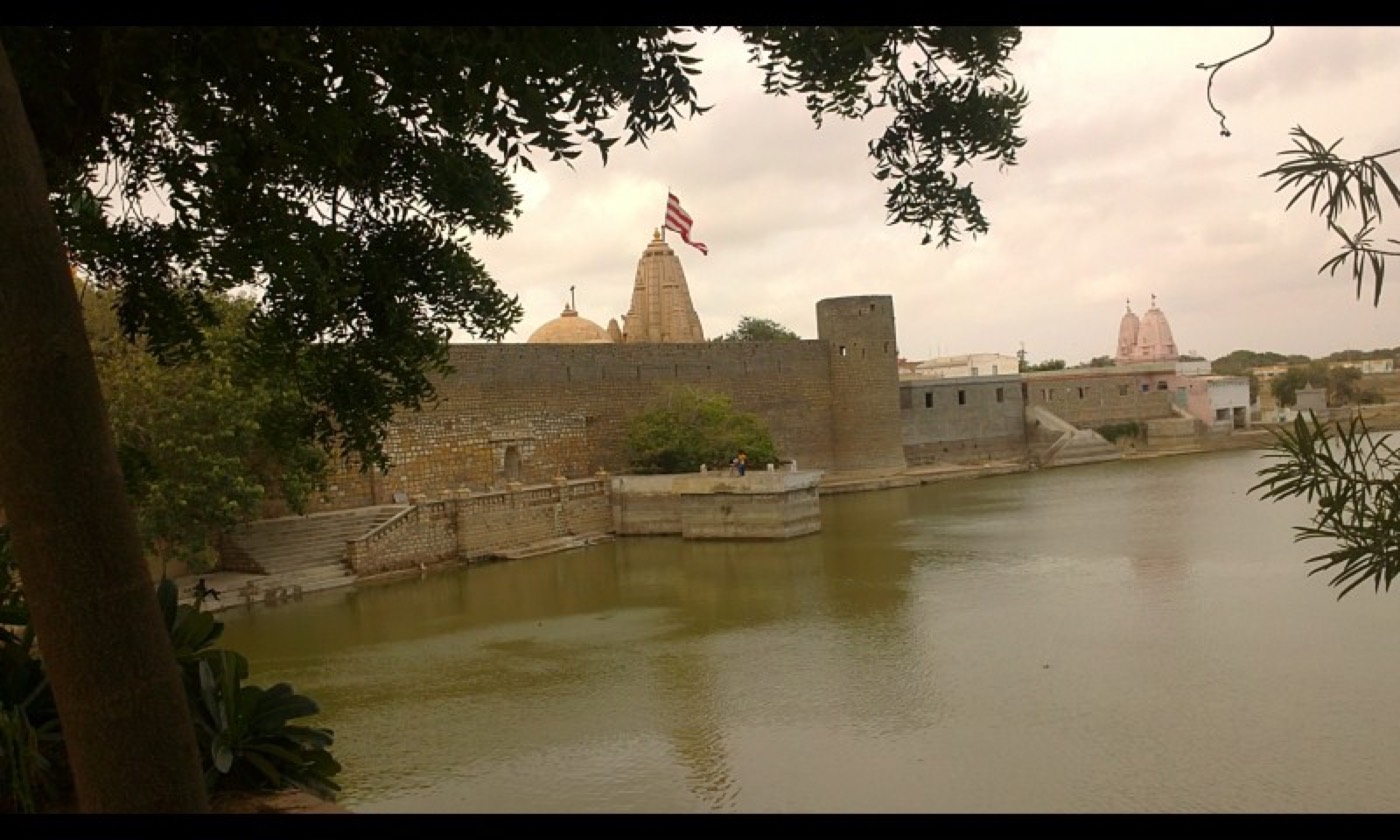
Bhadreshwar Vasai Jain Tirth sits in Mundra taluka, about 1 km inland from the Gulf of Kutch. Jain tradition dates the tirth to around 516 BCE, which would make it approximately 2,500 years old, and the 26 January 2001 earthquake levelled it completely. The Seth Vardhaman Kalyanji Trust rebuilt the complex stone by stone, and the marble courtyard now wraps its central shrine in 52 dev-kulikas. It is a working Shwetambar Deravasi tirth, not a monument, and entry is free.
Koteshwar and Narayan Sarovar are the other pole of the circuit, out in Lakhpat taluka where the road runs out of India. Koteshwar Mahadev stands on a spur of land above Kori Creek, the westernmost temple of the Indian mainland, its present structure raised in 1820 by Jetha Shivji and Seth Sundarji. Narayan Sarovar, roughly 2 km away by most accounts and up to 4 km by some, is one of the five Panch Sarovar lakes named in the Bhagavata Purana, ringed by a cluster of seven shrines.
A word of honesty before the tables. Kutch is enormous, public transport to both tirths is limited, and every timing published for them is approximate, with sources openly disagreeing on Koteshwar's hours. Treat this page as a planning frame, confirm the day's hours with the temple offices before committing to a long drive, and never start the western leg with half a tank or half an afternoon.
Bhadreshwar Vasai Jain Tirth in brief
The tirth carries the name of Bhadreshwar Parshwanath, yet the sources describe its shrines in overlapping ways: Mahavir Swami is the reconstructed mulnayak, while at least one source places Ajitnath in the central vedi. Rather than force a tidy answer, it is fairer to present all three descriptions together and let the pedhi explain the arrangement when you visit. What is not in dispute is the scale of the rebuilding after the 2001 earthquake, which returned the full 52 dev-kulika plan to the Kutch coast.
Practically, the derasar opens at approximately 6:00 AM daily and closes between approximately 8:00 and 8:30 PM, with the two published closing times differing by half an hour. The one firmly fixed ritual is the 6:00 AM morning aarti with prakshal and abhishek. The sanctum may close briefly at midday for the ashtprakari puja, as is standard Shwetambar practice, and the evening mangal divo floats with sunset. The pedhi office on 02838-282382 confirms same-day hours and takes dharamshala bookings, so one phone call removes most of the uncertainty.
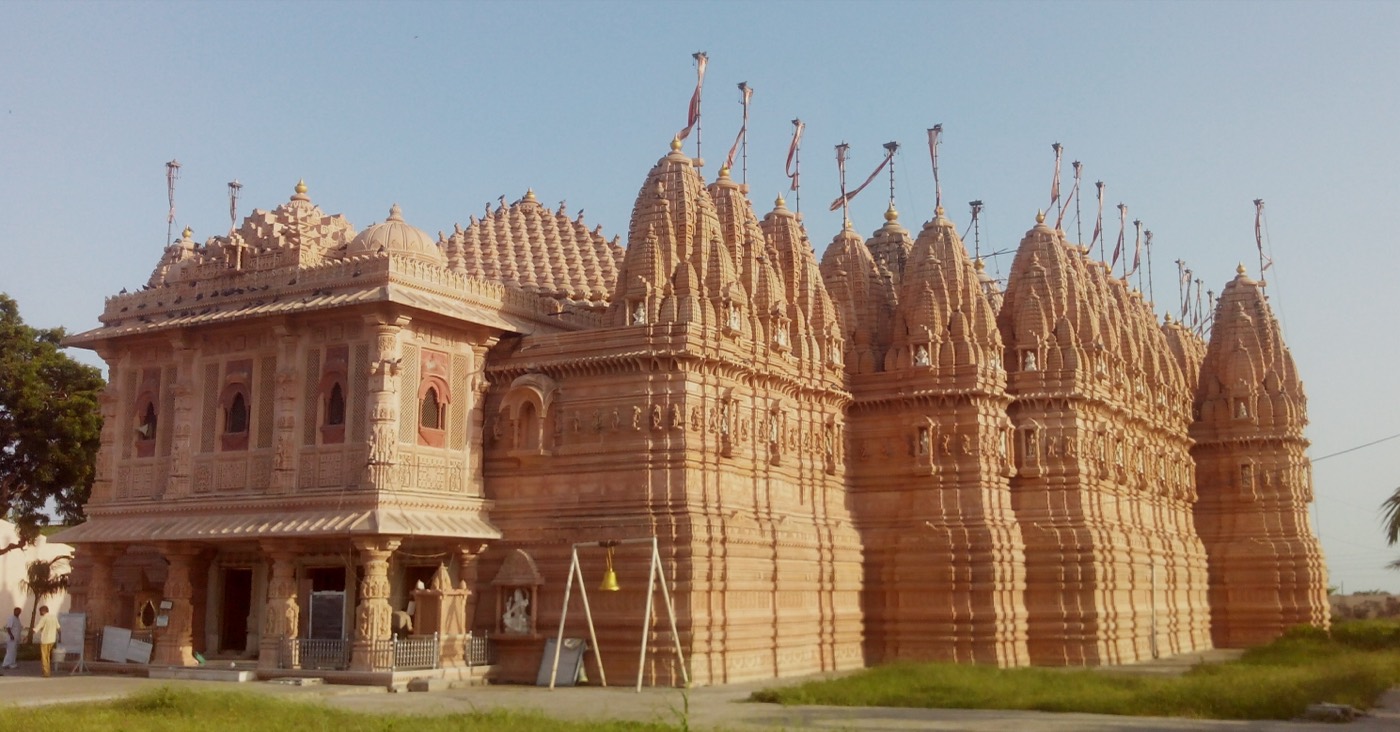
Koteshwar and Narayan Sarovar in brief
Koteshwar is a Shiva shrine that pilgrims visit as much for where it stands as for what it holds. It is the last temple before the open sea, and the sandhya aarti around sunset, with the water behind the shikhara, is the moment most visitors plan their day around. No official minute-by-minute aarti clock is published, so treat the sunset slot as an aim rather than an appointment.
Narayan Sarovar is the quieter half of the pair and the more ritually specific one. The lake is a place for a holy dip, the presiding deity is Shri Trikamray Narayan, and the shrine cluster follows the Vaishnava Pushtimarg tradition, so the pair puts a Shaiva seafront shrine and a Pushtimarg lake a short hop apart. Carry a change of clothes if you intend to bathe.
Distances from Bhuj and how to reach
Bhuj is the pivot of every Kutch itinerary, but it is not always the closest railhead. For Bhadreshwar, Gandhidham Junction at approximately 35 km is the better-connected station, with Kutch and Bhuj expresses from Ahmedabad and Mumbai; Bhuj station sits approximately 47 to 64 km away depending on the route, and Bhuj Airport approximately 50 km. Mundra town, approximately 27 km from the temple, is the closest hub for taxis and shared jeeps. For Koteshwar and Narayan Sarovar there is no argument: everything routes through Bhuj, approximately 160 km away, and the drive via Nakhatrana takes 4 to 5 hours on state roads with no frequent public buses at the far end.
The awkward number is the one between the two tirths themselves. Source estimates for the Bhadreshwar to Koteshwar road leg range from approximately 160 km to approximately 270 km, which is too wide a spread to plan on. Treat that connection as a long half day, check the route on the morning you drive it, and do not schedule an evening aarti at the far end of it.
| Leg | Distance | Notes |
|---|---|---|
| Bhuj to Bhadreshwar | Approx 47 to 64 km | Road leg via Mundra; Gandhidham Junction, approx 35 km, is the better railhead |
| Bhuj to Koteshwar and Narayan Sarovar | Approx 160 km, 4 to 5 hours | Via Nakhatrana; no frequent buses, hire a car or taxi |
| Mundra to Bhadreshwar | Approx 27 km | Closest taxi and shared-jeep hub |
| Mandvi to Bhadreshwar | Approx 60 to 69 km | Beach town often paired on a Kutch itinerary |
| Lakhpat fort to Koteshwar | Approx 15 km | Historic fort walls on the same coastal loop |
| Ahmedabad to Bhadreshwar | Approx 400 km, about 8 to 9 hours | Rough estimate, via Bhachau; verify before driving |
| Bhadreshwar to Koteshwar | Approx 160 to 270 km | Source estimates vary widely; treat as a long half day |
Darshan hours compared
The two sites keep different rhythms, and the difference decides your day plan. Bhadreshwar stays open through the day, so it forgives a late arrival. Koteshwar and the Narayan Sarovar shrines take a long midday break, roughly from noon until late afternoon, so arriving at one o'clock after a five-hour drive means waiting at the gate. Published hours for Koteshwar disagree between sources, quoted both as 5:00 AM to 12:00 PM with a 5:00 PM to 9:00 PM evening session, and as 6:00 AM to 1:00 PM with a 4:00 PM to 8:30 PM evening. That disagreement is exactly why the morning-or-evening rule matters more than any single printed time.
| Temple | Opens | Midday | Closes |
|---|---|---|---|
| Bhadreshwar Jain Tirth | Approx 6:00 AM | Open through the day; sanctum may close briefly for the midday puja | Approx 8:00 to 8:30 PM |
| Koteshwar Mahadev | Approx 5:00 to 6:00 AM | Long break from around noon to late afternoon | Approx 9:00 PM |
| Narayan Sarovar shrines | Approx 6:00 AM | Closed approx 12:00 PM to 4:00 PM | Approx 9:00 PM |
Planning the circuit with a Rann of Kutch trip
October to February is the season for the whole circuit. The coastal weather is dry and cool, and the window overlaps the Rann Utsav season, which runs roughly December to February, so the temples fold naturally into a wider Kutch trip. September into October has its own quiet reward, when the arid landscape turns briefly green after the rains. April to June is the stretch to avoid, and while neither tirth closes for the monsoon, buses and services across Kutch thin out from June to September.
The workable shape is two days based in Bhuj. Give the first full day to Koteshwar and Narayan Sarovar: leave early, use the temples' midday closure for the drive or for the short hop to Lakhpat fort, approximately 15 km from Koteshwar, and stay for the sunset aarti only if you are prepared to drive back in the dark or sleep at a dharamshala. Give the second day to Bhadreshwar via Mundra, pairing it with the beach town of Mandvi, approximately 60 to 69 km further along the coast. Fill the tank in Bhuj both mornings, because the far west of the district is not a place to gamble on fuel.
The circuit also connects outward. From Bhadreshwar, Palitana is the natural onward Jain pilgrimage at approximately 380 km, a rough estimate worth rechecking before you commit. From the Koteshwar side, Dwarka lies approximately 400 km away by road across the Gulf of Kutch, and Somnath approximately 500 km, both rough figures for what becomes a full western-Gujarat pilgrimage rather than a Kutch trip.
Festival windows worth planning around
Every festival below follows the lunar calendar, so the dates move each year and this table gives windows rather than days. The two that reshape the sites are Mahavir Jayanti at Bhadreshwar and Maha Shivratri at Koteshwar. Paryushan turns Bhadreshwar inward for eight days of fasting and pratikraman rather than crowding it, and the Kartik Purnima fair is when Narayan Sarovar fills with pilgrims for the holy dip.
| Festival | Usual window | Where it matters |
|---|---|---|
| Mahavir Jayanti | March or April (Chaitra Sud 13) | Bhadreshwar; the principal festival of the tirth, with special pujas |
| Paryushan Parva | August or September | Bhadreshwar; eight days of fasting, pratikraman and Samvatsari |
| Posh Dashami | December or January (Posh Vad 10) | Bhadreshwar; Janma Kalyanak of Bhagwan Parshwanath |
| Diwali and Mahavir Nirvana | October or November | Bhadreshwar; lamp-lit darshan and the Jain new year |
| Maha Shivratri | February or March | Koteshwar; night-long worship at the westernmost Shiva shrine |
| Shravan Somvar | July to August | Koteshwar; Monday abhishek draws a steady flow of devotees |
| Kartik Purnima | November | Narayan Sarovar fair and holy dip; higher footfall at Bhadreshwar too |
Dress and conduct at the two tirths
The two sites belong to different traditions and enforce different rules, and the Jain rules at Bhadreshwar are the stricter set, particularly on leather. The common floor at both is simple: dress modestly with shoulders and knees covered, leave footwear at the stands outside, keep silence near the sanctums, and ask before photographing anything.
- At Bhadreshwar, remove every leather item before entering: belts, wallets, purses, watch straps and bags. This is a strict Jain rule, not a courtesy.
- No photography inside the Bhadreshwar sanctum, and no eating, tobacco or gutka anywhere in the complex. Phones go on silent.
- Anyone performing puja or abhishek at Bhadreshwar bathes first and changes into fresh puja clothing; kesar and sukhad are available at the pedhi.
- By Jain custom, menstruating women traditionally do not enter the inner shrine; follow the notices and staff guidance on the day.
- At Koteshwar and Narayan Sarovar, traditional wear is welcome, leather is best left outside the sanctum, and photography inside the shrines is at the staff's discretion.
- Narayan Sarovar is a bathing tirth; carry a change of clothes for the dip.
Where to sleep, eat and refuel
At Bhadreshwar the answer is straightforward. The Seth Vardhaman Kalyanji Trust dharamshala stands at the tirth itself, with simple rooms for yatriks and an on-site bhojanshala serving Jain sattvik meals, booked through the pedhi on 02838-282382. Room categories and meal timings are not published in detail, so ask when you call. For more comfort, base at Mundra, Gandhidham or Bhuj and visit as a day trip.
The western end is more spartan. The temple trust runs a dharamshala near Narayan Sarovar with clean rooms reported at roughly 200 to 250 rupees a night, a figure from traveller reports that may have changed, and an Annakshetra serving free meals to pilgrims. A few more trust-run dharamshalas sit along the road between the lake and Koteshwar. They are fine for a night, but carry your own essentials. Hotels mean Bhuj, approximately 160 km back, where options run from budget stays like Usha Residency to mid-range hotels such as Hotel Atithi and Canyon Inn, or the nearer town of Nakhatrana. Many visitors simply do the western pair as a full-day trip from Bhuj and skip the overnight.
Frequently asked questions
How far is Koteshwar temple from Bhuj?
What are the darshan timings of Bhadreshwar Jain temple?
Can I visit Koteshwar and Narayan Sarovar in one day from Bhuj?
Which is the westernmost temple in India?
Where can I stay near Narayan Sarovar and Koteshwar?
When is the Narayan Sarovar fair held?
Compiled from our verified temple guides and public sources including Wikipedia: Bhadreshwar Jain Temple · TourMyIndia: Bhadreshwar Jain Temple · Trawell.in, Koteshwar Mahadev Temple · Incredible India, Narayan Sarovar · Wikipedia, Narayan Sarovar. Timings and festival dates shift with the lunar calendar; confirm before you travel.