Braj, the countryside of Krishna's childhood, spreads across Vrindavan, Mathura and the villages around them. A first-time visitor usually wants the same practical answers: which temples to anchor the day on, when each one actually opens, and how to move between them without losing hours to the town's narrow lanes. This guide works from verified data on two temples, Banke Bihari and Prem Mandir, and treats the rest of Braj as context rather than pretending to cover it all.
The two anchors could hardly be more different. Banke Bihari is a mid-19th century shrine buried deep in old Vrindavan's galiyara, reached on foot through a bazaar lane, where the deity is treated as a living child who is woken late and rested through the middle of the day. Prem Mandir opened in 2012 on the Vrindavan-Mathura road, set in approx 55 acres of gardens and lawns, built in hand-carved Italian marble by Jagadguru Kripalu Maharaj's organisation. One is intimate and crushing, the other spacious and choreographed.
Both temples close for a long midday break, and both are free to enter. That shared rhythm is what makes a one-day plan work: morning in the old town, rest through the afternoon, evening on the marble lawns. The sections below put the timings side by side, give the transport table for arrivals from Delhi and Mathura, and map the festival windows when the whole plan changes.
Two very different temples in one town
Banke Bihari holds the black-stone idol that Swami Haridas is said to have summoned from Nidhivan, worshipped in the bent Tribhanga stance as the combined form of Radha and Krishna. The signature of darshan here is the curtain: sevaks repeatedly draw the parda across the shrine and pull it back, so darshan comes in short, deliberate bursts and no devotee holds an unbroken gaze. There is no daily pre-dawn Mangala aarti at all. The temple performs one only once a year, on Janmashtami, because Bihariji is deliberately woken late.
Prem Mandir is the opposite proposition. Radha Krishna occupy the ground level and Sita Ram the first floor, the marble walls carry hand-carved leela panels, and the gardens hold life-size dioramas of the Jhulan, Govardhan, Raas and Kaliya Naag leelas. Construction began in January 2001 and the temple opened to the public on 17 February 2012, at a reported cost of about Rs 150 crore. It is built for volume, with airport-style security at the gate and free shoe counters, and it absorbs a festival crowd in a way the old town's lanes never can.
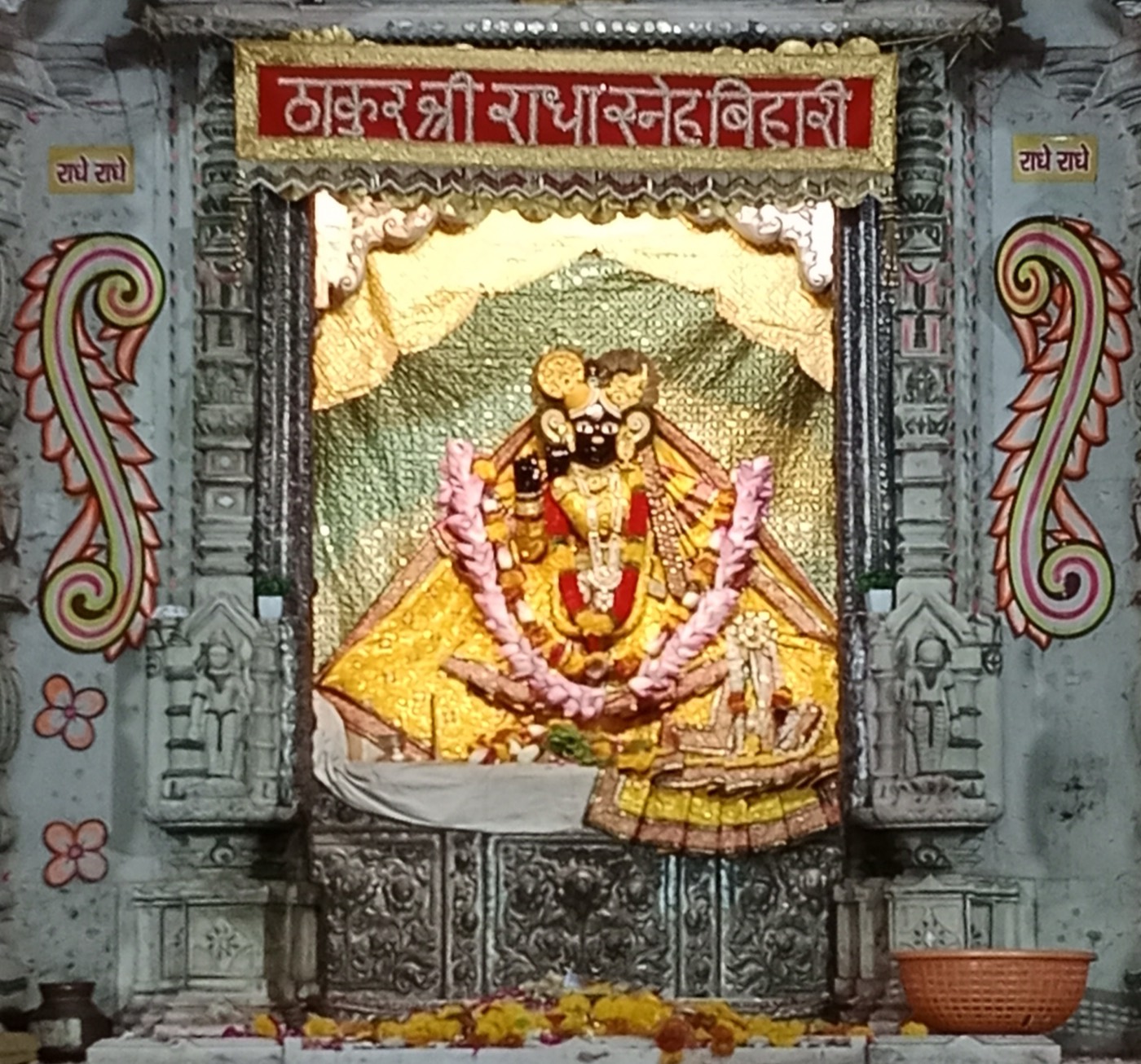
Shri Banke Bihari Temple, Vrindavan
Mathura, Uttar Pradesh
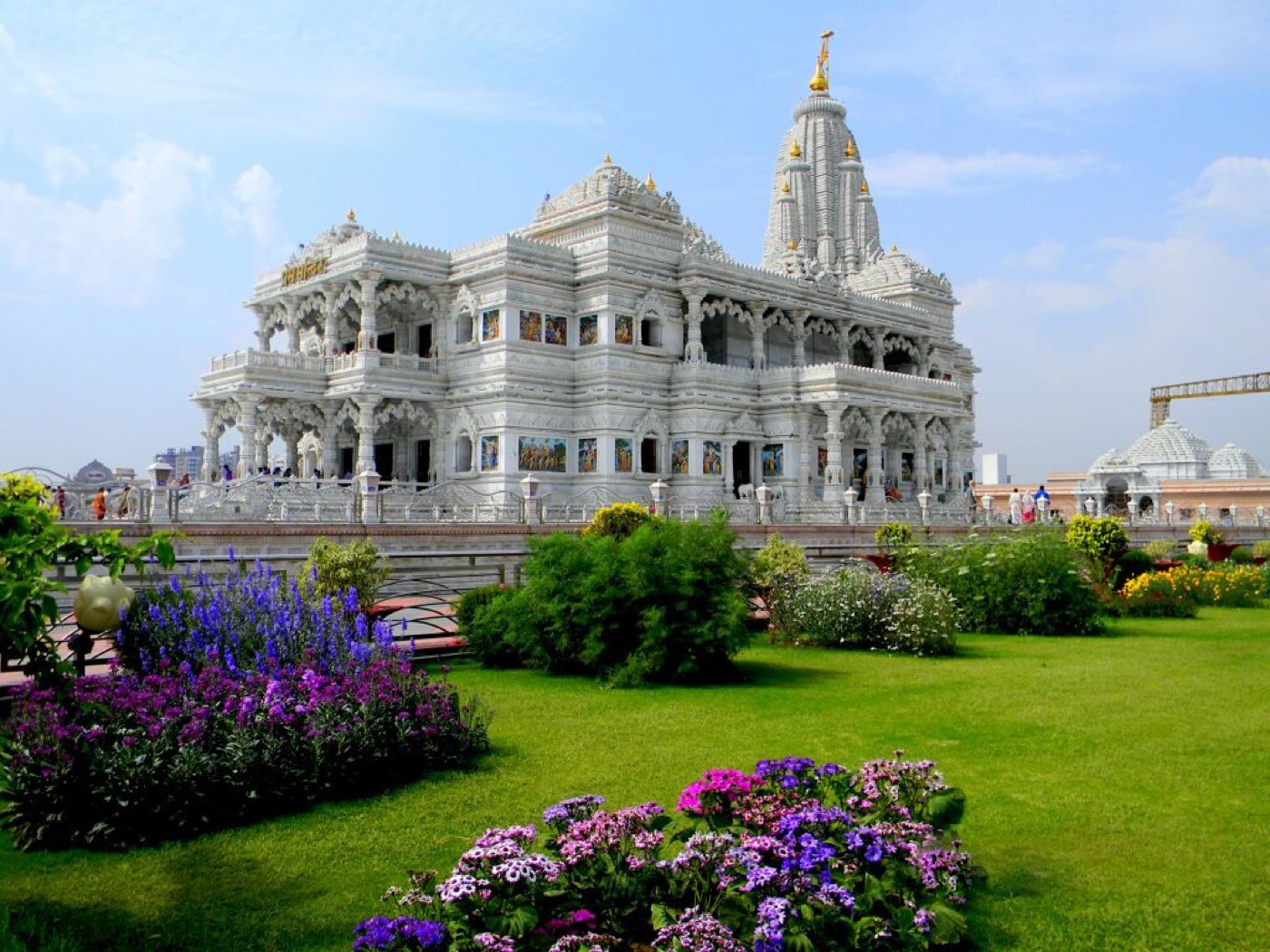
Prem Mandir, Vrindavan
Mathura, Uttar Pradesh
Darshan timings, side by side
Banke Bihari runs a seasonal clock. Summer hours, roughly mid-March to October, start at 7:45 AM; winter hours, roughly November to February, start an hour later at 8:45 AM, and the switch follows the temple's own calendar rather than fixed dates, so confirm locally near the changeover. Prem Mandir keeps the same darshan hours all year, and only its fountain show shifts by half an hour between summer and winter.
The table below puts the two side by side. The pattern to remember is the shared midday closure: from noon, or 1:00 PM on Banke Bihari's winter schedule, until late afternoon, neither temple offers darshan, so the middle of the day belongs to lunch, rest or the road. Timings at both temples are extended or shifted on major festival days.
| Session | Banke Bihari | Prem Mandir |
|---|---|---|
| Morning, summer | 7:45 AM to 12:00 PM (approx mid-March to October) | 8:30 AM to 12:00 noon, all year |
| Morning, winter | 8:45 AM to 1:00 PM (approx November to February) | 8:30 AM to 12:00 noon, all year |
| Evening, summer | 5:30 PM to 9:30 PM | 4:30 PM to 8:30 PM, all year |
| Evening, winter | 4:30 PM to 8:30 PM | 4:30 PM to 8:30 PM, all year |
| Midday | Closed between sessions for deity rest | Closed 12:00 noon to 4:30 PM |
| Entry | Free, no official online VIP pass | Free, no ticket for darshan |
A one-day sequence that works
Start at Banke Bihari at opening. The calmest darshan of the week is a weekday right when the doors open, and Monday mornings are the calmest of all. Vehicles, including e-rickshaws, stop several hundred metres from the temple, so budget time for the walk in through the bazaar galiyara, and travel light, because the crowd is dense and pickpocketing in the packed lane is a real risk.
Spend the late morning inside if you want the full arc: Shringar darshan comes when the doors open and the Rajbhog aarti and bhog offering follow at approx 11:00 AM to 12:00 PM, before the shutters close for the deity's rest. Then surrender to the midday break the way the deities do. In the late afternoon, cross town to Prem Mandir for the 4:30 PM reopening and evening aarti. The two temples sit approx 2.5 to 5 km apart depending on the route, an easy e-rickshaw hop.
Stay at Prem Mandir for the fountain show, then decide by season. In summer, Banke Bihari's evening session runs until 9:30 PM, so after the show ends at 8:00 PM you can return to the old town for a second, night-time jhanki darshan. In winter the arithmetic is tighter, with the show ending at 7:30 PM and Banke Bihari closing at 8:30 PM, so treat the fountain as the finale.
The evening light show, and when to reach the lawns
Prem Mandir's musical light-and-water fountain show runs 7:30 to 8:00 PM from 1 April to 30 September and 7:00 to 7:30 PM from 1 October to 31 March. The complex fills up fastest in the last hour before the show, so reach the lawns by around 6:45 PM in winter or 7:15 PM in summer to get a clear spot. Around the show sit the other fixed points of the evening: parikrama of the main shrine at approx 7:00 PM and shayan aarti at approx 8:10 PM, before the temple closes at 8:30 PM.
Two practical notes for the evening. In winter the white marble underfoot gets genuinely cold, so carry socks. And photography is generally allowed in the gardens and of the exterior, but respect any no-photography signs inside the sanctum and during aarti, and expect bag checks at the gate, with larger bags going to the cloakroom.
Reaching Vrindavan from Delhi, Mathura and beyond
Mathura Junction is the reliable railhead, approx 12 km away on the Delhi-Agra-Mumbai trunk route, with autos, taxis and shared tempos covering the onward stretch in about 30 to 45 minutes in traffic. Vrindavan's own small branch-line station, approx 5 to 6 km out, has far fewer trains and suits only those already in Mathura. From Delhi, the practical run is approx 150 km down the Yamuna Expressway or NH 44, roughly 3 to 4 hours by road, and Akshardham in Delhi, with its own evening water show, makes a natural stop on that drive in either direction.
By air, Agra's Kheria airport is nearest at approx 70 to 72 km but has limited scheduled flights, and Noida International Airport at Jewar, opened in 2026, is a newer option to the north whose connectivity is worth checking at booking time. For most visitors, flying into Delhi and driving down is the sensible default. Remember that no vehicle reaches Banke Bihari's lane itself; e-rickshaws and your own feet do the final approach everywhere in the old town.
| Mode | Entry point | Distance | Notes |
|---|---|---|---|
| Rail | Mathura Junction | approx 12 km | Best-connected railhead, on the Delhi-Agra-Mumbai trunk route; auto, taxi or shared tempo onward, 30 to 45 minutes in traffic |
| Rail, local | Vrindavan railway station | approx 5 to 6 km | Small branch-line station with limited services |
| Air, nearest | Agra (Kheria) Airport | approx 70 to 72 km | Limited scheduled flights; road transfer about 1.5 to 2 hours |
| Air, major | Delhi (Indira Gandhi International) | approx 150 km | 3 to 4 hours by road via the Yamuna Expressway or NH 44 |
| Road | Mathura city | approx 12 to 13 km | Frequent buses, taxis and autos on the Mathura-Vrindavan road; park in the outer lots and continue by e-rickshaw |
Festival windows across the Braj year
Every major festival here follows the lunar calendar, so the dates move each year and the honest way to plan is by window, not by date. Janmashtami, in August or September, is the single biggest night in Vrindavan and the one night of the year Banke Bihari holds a Mangala aarti, with darshan running through the night into the early hours. Holi, in February or March, turns the whole Vrindavan-Mathura-Barsana belt festive for days, and Banke Bihari's Phoolon wali Holi has priests showering devotees with petals and coloured water while Bihariji is placed in a silver enclosure for closer darshan.
Two quieter windows matter for darshan completists. Akshaya Tritiya, in April or May, is the only day of the year Bihariji's feet are revealed, dressed with sandalwood; the rest of the year the idol stays clothed to the feet. Sharad Purnima in October, the full moon of the raas leela, is marked at both temples with special adornment. Book accommodation well ahead for Janmashtami, Radhashtami and Holi, when the whole Braj region sells out, and remember Mathura's hotels are the usual fallback when Vrindavan is full.
| Festival | Window | What happens |
|---|---|---|
| Janmashtami | August or September | Krishna's birth; Banke Bihari's only Mangala aarti of the year with night-long darshan; Prem Mandir elaborately lit, long queues |
| Holi, incl. Phoolon wali Holi | February or March | Flower Holi at Banke Bihari with petals and coloured water; the whole Braj belt celebrates for days |
| Akshaya Tritiya | April or May | Charan darshan at Banke Bihari, the one day of the year the deity's feet are shown |
| Hariyali Teej / Jhulan Yatra | July or August | Monsoon swing festival; Bihariji, dressed in green, seated on a decorated jhoola for a rare open darshan |
| Radhashtami | August or September, about 15 days after Janmashtami | Radha's appearance day; special shringar and heavy footfall at both temples |
| Sharad Purnima | October | Raas leela full moon; special adornment and moonlit darshan |
| Diwali and Annakut | October or November | Prem Mandir's complex and gardens illuminated; Govardhan Puja and Annakut follow Diwali |
Crowd math and the dress code
The crowd pattern at Banke Bihari is consistent: weekends and festival mornings bring the heaviest crush, a weekday right at opening is the calmest window, and Monday mornings are the quietest of all. At Prem Mandir the pressure point is different, because the complex fills fastest in the last hour before the fountain show, so the earlier you settle on the lawns, the easier the evening. On weather, October to March is the most comfortable stretch in Braj, while April to June is very hot, which is when an evening-heavy plan earns its keep.
Dress matters more at Banke Bihari, where a stated code is enforced: shoulders and knees covered, with shorts, half-pants, bermudas, mini skirts, night suits and torn or ripped jeans turned away. Traditional wear is simplest, a saree or salwar-suit for women and a shirt with trousers or kurta-pyjama for men. Prem Mandir is comparatively relaxed but is still an active place of worship, so modest clothing with shoulders and knees covered is expected there too.
In the Banke Bihari crush, keep children close, hold bags and valuables tight, and use the shoe-deposit stalls in the approach lane so you carry only what you need. Do not push toward or climb the steps of the jagmohan for a closer view; crowd-safety rules restrict this after past overcrowding incidents. Phone use inside the sanctum is discouraged and often restricted; do not try to film the deity during darshan.
The rest of Braj, honestly
A full Braj circuit includes far more than these two temples, and this guide does not pretend to cover the rest. Krishna Janmabhoomi in Mathura marks the traditional birthplace of Krishna. Nidhivan, the walled grove inside Vrindavan, is where Swami Haridas is said to have summoned the Banke Bihari idol, and it remains bound up with the raas leela tradition. Govardhan draws parikrama pilgrims and connects to the Annakut festival that follows Diwali, and Barsana, Radha's town, anchors the region's famous Holi. We have not verified timings, fees or rules for any of these four, so treat them as names to research separately rather than stops this page can plan for you.
For a longer Uttar Pradesh circuit, Ram Mandir in Ayodhya, approx 400 km away, is often paired with Braj on extended temple trips. There is also a historical thread worth following west: Govind Dev Ji in Jaipur, approx 210 to 230 km by road, houses a Krishna deity whose worship traces back to Vrindavan itself, moved in the Mughal era to escape iconoclasm.
Frequently asked questions
Can you visit Banke Bihari and Prem Mandir in one day?
What time is the light show at Prem Mandir?
How do I reach Vrindavan from Delhi?
Is there an entry fee for Banke Bihari or Prem Mandir?
Which day is Banke Bihari temple least crowded?
What is the dress code for Vrindavan temples?
Compiled from our verified temple guides and public sources including Banke Bihari Temple, Wikipedia · Official Prem Mandir / JKP site (timings and fountain show) · Wikipedia: Prem Mandir, Vrindavan · Banke Bihari Mandir Timings 2026, Travelshexa. Timings and festival dates shift with the lunar calendar; confirm before you travel.