The two shrines could hardly feel more different. Kalighat is a Shakti Peeth folded into the lanes of south Kolkata, loud and close, with a flower market pressed against its approaches and an unending queue for the black-stone face of Dakshina Kali. Dakshineswar is a walled riverside complex on the east bank of the Hooghly, built by Rani Rashmoni between 1847 and 1855, its nine-spired temple ringed by twelve identical Shiva shrines, with a bathing ghat where pilgrims touch the river before darshan.
By road the two are far apart, somewhere between approx 15 and 24 km depending on which route you take across the city, and Kolkata traffic makes that an unpredictable drive. The metro removes the guesswork. Kalighat station on the Blue Line is approx 0.5 km from one temple, and the same line ends at Dakshineswar station, approx 0.5 km from the other. You board a train in the south and step off at the northern terminus.
This guide puts the two timing schedules side by side, explains which temple to take first and why, lays out a half-day and a full-day plan, and covers the ferry that links Dakshineswar with Belur Math across the river. Belur Math itself does not have a page on this site, so we name it as context rather than pretending to cover it.
Two Kalis, one city
Kalighat is the older seat in spirit, the temple popularly credited with giving the city its name. The present structure was completed in 1809 by the Sabarna Roy Choudhury family, but the sanctity is older: this is the Shakti Peeth where the right toes of Devi Sati are said to have fallen. The image inside is a black touchstone face with three large golden eyes and a protruding gold tongue, worshipped as Dakshina Kali, and the temple stands by the Adi Ganga, the old channel of the river also called Tolly's Nala. Its guardian Bhairava, Nakuleshwar Mahadev, is worshipped nearby.
Dakshineswar is younger and grander in build. Rani Rashmoni raised the navaratna temple between 1847 and 1855, and the deity, Bhavatarini Kali standing on a supine Shiva upon a silver lotus, was installed on 31 May 1855, on Snana Yatra day. The nine-spired temple rises over 100 ft, with twelve aat-chala Shiva temples in a line, a Radha-Krishna temple, bathing ghats on the Hooghly, and the room where Sri Ramakrishna lived. He served here as priest for approx 30 years, and that association, as much as the goddess herself, is what draws many visitors.
Treat them as two halves of one darshan rather than ranking them. Kalighat gives you the raw, pressing intensity of a living Shakti Peeth. Dakshineswar gives you river air, architecture and the Ramakrishna story. A day that holds both is more complete than a day spent wholly at either.
| Kalighat | Dakshineswar | |
|---|---|---|
| Deity | Dakshina Kali, black touchstone face with three golden eyes and a gold tongue | Bhavatarini Kali, standing on a supine Shiva on a silver lotus |
| Standing | Shakti Peeth, right toes of Devi Sati | Navaratna temple over 100 ft tall, ringed by 12 Shiva shrines |
| Present structure | Completed 1809 by the Sabarna Roy Choudhury family | Built 1847 to 1855 by Rani Rashmoni |
| River | Adi Ganga (Tolly's Nala) | East bank of the Hooghly |
| Nearest metro | Kalighat station, approx 0.5 km | Dakshineswar station (Blue Line terminus), approx 0.5 km |
| Entry | Free general darshan; paid seva at official counters | Free; bhog coupon approx Rs 50, booked before 9:30 AM |
| From the airport | approx 17 to 19 km, about 45 to 75 minutes by taxi | approx 9 to 14 km by road, about 30 to 45 minutes |
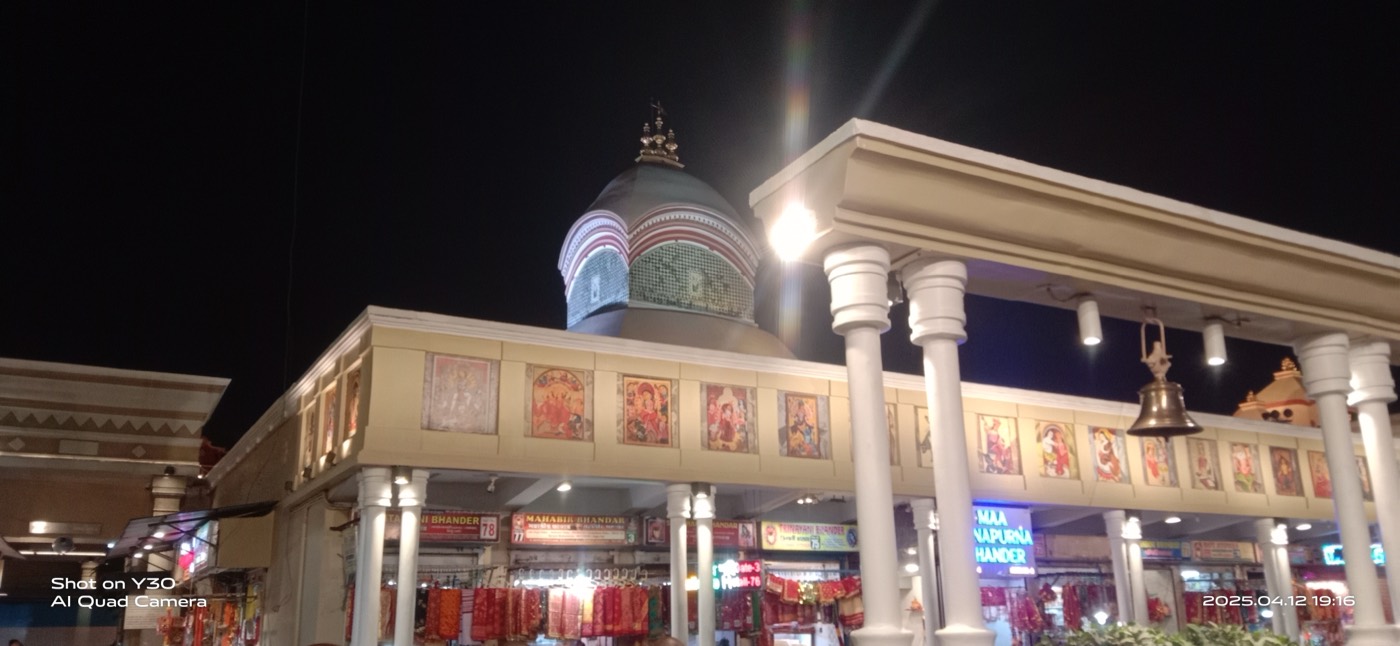
Kalighat Kali Temple
Kolkata, West Bengal
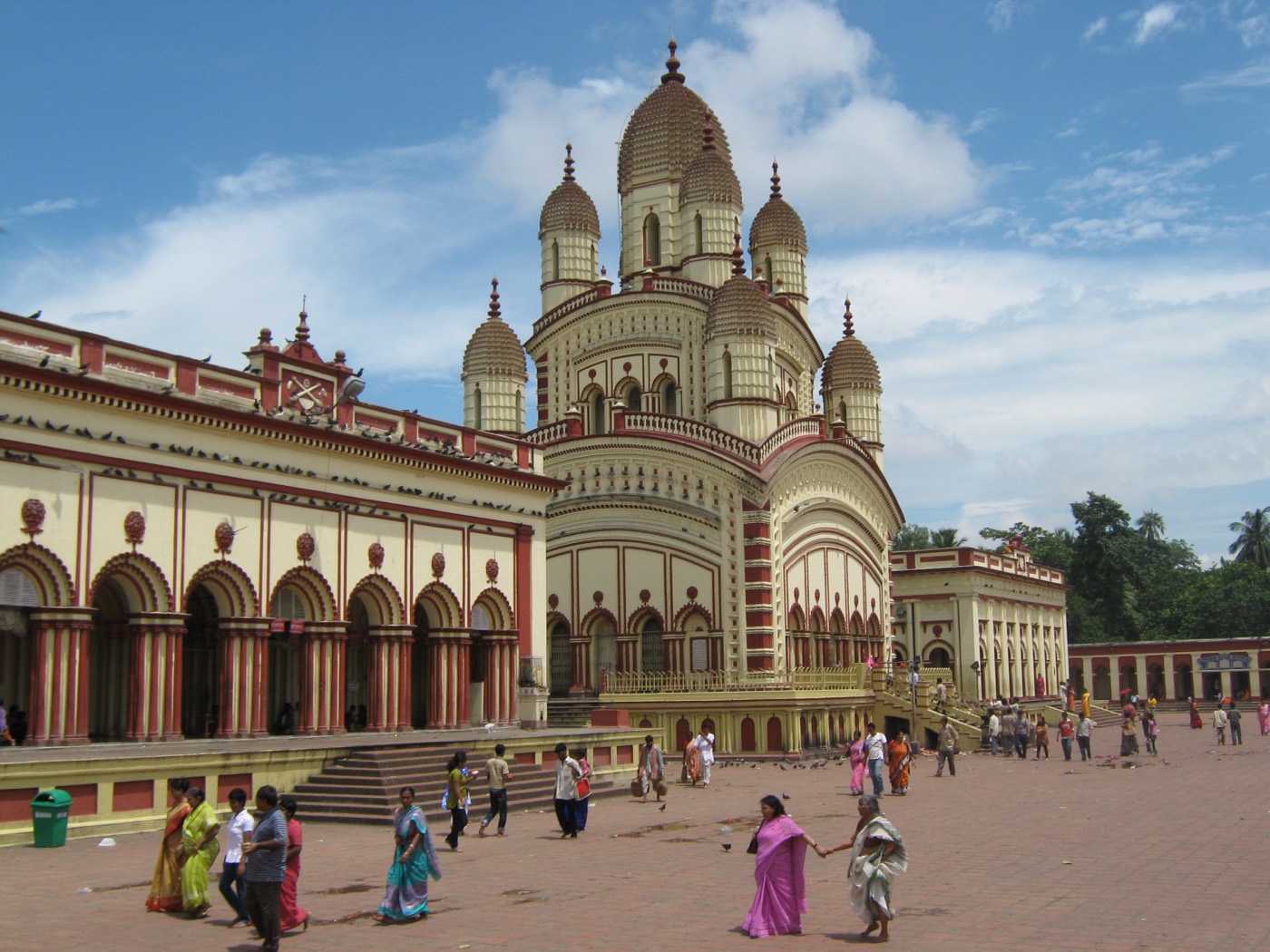
Dakshineswar Kali Temple
North 24 Parganas, West Bengal
Timings side by side
The midday breaks are the whole puzzle of this day. Kalighat runs the same pattern year round: open from 5:00 AM to 2:00 PM, shut from 2:00 PM to 5:00 PM for bhog and cleaning, then open again from 5:00 PM to 10:30 PM. Dakshineswar splits by season instead. In the summer months it runs approx 5:30 AM to 11:30 AM and 3:30 PM to 9:00 PM, and in winter approx 6:00 AM to 12:30 PM and 3:00 PM to 8:30 PM. Neither schedule is published to the minute on an official calendar, so treat every time here as approx and confirm on the day you travel.
Read the table and one fact jumps out. From 2:00 PM until Dakshineswar reopens at 3:00 PM in winter or 3:30 PM in summer, both sanctums are shut at once, and Kalighat stays shut until 5:00 PM. That dead zone is your lunch, your rest, or your ferry ride. Mornings are open at both, evenings are open at both, and Kalighat runs latest, until 10:30 PM.
| Session | Kalighat (daily) | Dakshineswar (summer) | Dakshineswar (winter) |
|---|---|---|---|
| Morning opens | 5:00 AM | 5:30 AM | 6:00 AM |
| Closes for break | 2:00 PM | 11:30 AM | 12:30 PM |
| Reopens | 5:00 PM | 3:30 PM | 3:00 PM |
| Evening closes | 10:30 PM | 9:00 PM | 8:30 PM |
| Evening aarti | around 6:30 PM | 7:00 PM | 6:30 PM |
The metro logic: one line, both temples
The Blue Line, Kolkata's Line 1, is the spine of this plan. Kalighat station sits approx 0.5 km from the southern temple, a walk of roughly 5 to 10 minutes through the flower and puja-goods market. The same line runs north and terminates at Dakshineswar station, from which the temple gate is another approx 0.5 km signposted walk. There are no line changes and no traffic to sit in.
Avoid driving between the two if you can. The lanes around Kalighat are narrow, one way and choked by the market, so cars are best left a few blocks away, and Dakshineswar sits approx 16 to 20 km up BT Road from central Kolkata. If you are starting from the Sealdah side, suburban EMU trains on the Sealdah to Dankuni line reach Dakshineswar railway station in roughly 30 to 40 minutes, and that station is approx 0.5 to 0.7 km from the temple on foot.
A half-day plan and a full-day plan
The half-day version runs south to north. Be at Kalighat for the 5:00 AM opening, when the Mangala Aarti period runs from approx 5:00 AM to 7:00 AM and the queue is at its thinnest. Take darshan, walk back to the metro and ride the Blue Line to its Dakshineswar terminus. Your deadline is the northern temple's midday close, 11:30 AM in summer and 12:30 PM in winter, so the earlier you leave Kalighat the more slack you carry.
The full-day version runs north to south and eats better. Start at Dakshineswar's opening, 5:30 AM in summer or 6:00 AM in winter, and book a bhog coupon before the 9:30 AM cutoff; it costs approx Rs 50 and the khichuri prasad is distributed from approx 11:45 AM. While the temple takes its afternoon break, cross the Hooghly by ferry to Belur Math. Then ride the metro south for Kalighat's evening session, 5:00 PM to 10:30 PM, with the aarti around 6:30 PM. You will have seen both temples, eaten the temple's own bhog and crossed the river, all on public transport.
One honest trade-off: each temple has an evening aarti worth planning around, Dakshineswar's Sandhya Aarti at 7:00 PM in summer or 6:30 PM in winter, and Kalighat's around 6:30 PM, and they overlap. Pick one evening and accept the other temple in its morning light.
| Slot | Half-day (south to north) | Full day (north to south) |
|---|---|---|
| Early morning | Kalighat from its 5:00 AM opening, during the Mangala Aarti period (approx 5:00 AM to 7:00 AM) | Dakshineswar from opening (5:30 AM summer, 6:00 AM winter); book the bhog coupon before 9:30 AM |
| Late morning | Blue Line metro north; enter Dakshineswar before its midday close (11:30 AM summer, 12:30 PM winter) | Darshan, the 12 Shiva shrines and the Ramakrishna room; bhog distribution from approx 11:45 AM |
| Afternoon | Day complete by early afternoon; both sanctums are shut for their breaks anyway | Ferry across the Hooghly to Belur Math while Dakshineswar is closed |
| Evening | Optional: stay north for Dakshineswar's Sandhya Aarti (7:00 PM summer, 6:30 PM winter) | Metro south for Kalighat's evening session, 5:00 PM to 10:30 PM, aarti around 6:30 PM |
The Belur Math ferry
Dakshineswar holds one travel detail that changes the shape of the day: a ferry across the Hooghly links the temple with Belur Math, so pilgrims can combine both shrines in a single river crossing. Belur Math, the monastic centre of the Ramakrishna order, sits on the opposite bank. We do not maintain a page for it, so we will not quote its timings here, but the crossing itself is the natural way to spend Dakshineswar's midday break.
The Ramakrishna thread ties this geography together. He served as Dakshineswar's priest for approx 30 years, his room still stands within the complex, and two observances on the temple calendar carry his memory: Kalpataru Utsav on 1 January, kept across Ramakrishna sites, and Phalaharini Kali Puja on the Amavasya of Jyeshtha, in May or June, the night he is traditionally said to have worshipped Sarada Devi as the Goddess.
When to go and when to brace for crowds
October to March is the comfortable window for both temples, with cool, dry weather for Kalighat's packed lanes and Dakshineswar's riverside queues. The crowd calendar is identical at the two: Tuesdays, Saturdays and every Amavasya draw the heaviest devotional footfall, so a weekday morning outside those days is the calm choice. At Kalighat, arriving before about 8 AM makes a visible difference.
Festivals follow the lunar calendar and move each year, so plan by window, not by date. Kali Puja, on the Amavasya of Kartik in October or November, is the biggest night at both temples at once: worship runs through the dark hours and Kalighat's darshan hours extend, sometimes round the clock. Durga Puja, in September or October, floods the whole city and spills into both shrines.
- Kali Puja: Amavasya of Kartik, October or November; the peak night at both temples, with worship through the night
- Durga Puja: Ashwin, September or October; city-wide festivity and heavy footfall at both
- Navratri at Kalighat: twice yearly, March or April and September or October
- Snan Yatra at Kalighat: Jyeshtha Purnima, in June; priests are said to blindfold themselves while bathing the goddess
- Snana Yatra at Dakshineswar: Jyeshtha full moon, late May or June; also the anniversary of the deity's installation on 31 May 1855
- Phalaharini Kali Puja at Dakshineswar: Amavasya of Jyeshtha, May or June
- Kalpataru Utsav at Dakshineswar: 1 January
- Poila Boishakh at Kalighat: mid-April, Bengali New Year darshan
Rules, queues and the realities on the ground
The etiquette is shared: dress modestly with shoulders and knees covered, leave footwear at the stalls outside rather than carrying it in, and keep the camera away inside either sanctum. Dakshineswar goes further than most city temples: traditional Indian wear is preferred over Western clothing, leather items are best left outside, and bags pass security checks with cloakroom limits, so carry as little as possible.
Kalighat asks for a different kind of street-craft. Self-appointed pandas and touts offer to fast-track darshan for a fee; decline, and use the official counters for any paid seva or puja. The queue and the market attract pickpockets, so keep phones and wallets secured. Be aware too that animal sacrifice, chiefly of goats, still takes place at the temple on certain days; visitors uncomfortable with it should stay away from the balidan area.
- Cover shoulders and knees at both temples; saree, salwar kameez, kurta-pyjama or dhoti preferred at Dakshineswar
- Shoes go to the keeping stalls outside, never inside
- No photography inside either sanctum; follow the priests' instructions
- Book any paid seva at Kalighat through the official counters only
- Move aside quickly after darshan at Dakshineswar; the line moves fast on busy days
Where this trail leads next
Both temples point beyond themselves. For Shakti pilgrims the natural continuation east is Kamakhya in Guwahati, approx 1,000 km away by overnight train or a flight, the most powerful Shakti Peeth of the east. Southward, the Jagannath temple at Puri on the Odisha coast, approx 500 km by train, is the classic next leg of an eastern pilgrimage.
Bengal itself holds more Kali geography than one day can carry. Tarapith, the famous Tantric seat in Birbhum, is not covered on this site, so we will not invent details for it, but devotees often name it in the same breath as these two. For the wider Shakti Peeth trail across India, our pages on Ambaji in Gujarat and Vindhyavasini near Mirzapur pick up the thread.
Frequently asked questions
Can you visit Kalighat and Dakshineswar in one day?
Which temple should I visit first, Kalighat or Dakshineswar?
Is Dakshineswar temple open in the afternoon?
How do I get from Kalighat to Dakshineswar by metro?
What is the dress code at Kalighat and Dakshineswar temples?
When is Kali Puja celebrated at the Kolkata Kali temples?
Compiled from our verified temple guides and public sources including Kalighat Temple - Wikipedia · Wikipedia: Dakshineswar Kali Temple · Dakshineswar Kali Temple official website · West Bengal Tourism: Dakshineswar. Timings and festival dates shift with the lunar calendar; confirm before you travel.