Madhya Pradesh holds two of the twelve Jyotirlingas, the shrines of Shiva's light scattered across India from Somnath on the Gujarat coast to Kedarnath in the Himalaya. Mahakaleshwar in Ujjain is the only one of the twelve whose lingam faces south, and its Bhasma Aarti, held around 4 am, in which the deity is bathed in sacred ash, is a ritual no other Jyotirlinga performs. Omkareshwar, approx 140 km away in Khandwa district, splits its sacred light between two shrines, one on Mandhata island and one on the mainland bank, so a proper darshan there takes in both.
The pairing works because of Indore. The city's airport sits approx 55 km from Ujjain and approx 83 km from Omkareshwar, so one arrival serves both temples. Most pilgrims take Ujjain first for a hard practical reason: the Bhasma Aarti happens around dawn, so it demands a night in Ujjain, and its permit needs booking before anything else in the trip is fixed.
This guide covers the two temples, the transport that stitches them together, the festival calendar that decides your crowds, and a longer loop east to Maihar Sharda, the hilltop Shakti shrine above the Mumbai-Howrah main line. It does not attempt Indore city itself, and it stays honest about distances: Maihar is approx 500 km from Ujjain, an extension for pilgrims with a week, not a weekend.
Why Ujjain and Omkareshwar pair so naturally
Each temple would justify a journey on its own. Mahakaleshwar stands near the Shipra river in old Ujjain, one of Hinduism's seven mokshapuris and a Simhastha Kumbh city. Its lingam is swayambhu, self-manifested, and uniquely south-facing among the twelve, the direction associated with time and death, so Shiva is worshipped here as Mahakal, Lord of Time. General darshan runs approx 4:00 am to 11:00 pm daily and is free, though the sanctum can be restricted on busy days.
Omkareshwar is a different kind of visit. The Narmada has cut Mandhata island into the shape of the syllable Om, and the Jyotirlinga is worshipped as twin lingas, Omkareshwar on the island and Mamleshwar, also called Amareshwar, on the mainland bank. Devout pilgrims complete the approx 7 km parikrama around the island as well, so the visit is a slow half day at minimum rather than a queue and a glimpse. Entry is free, with a Shighra darshan ticket at approx Rs 300 per person for a faster line.
Done together, they give you both moods of Madhya Pradesh Shaivism: the ash-smeared intensity of Mahakal before dawn, and the riverine calm of an island circuit.
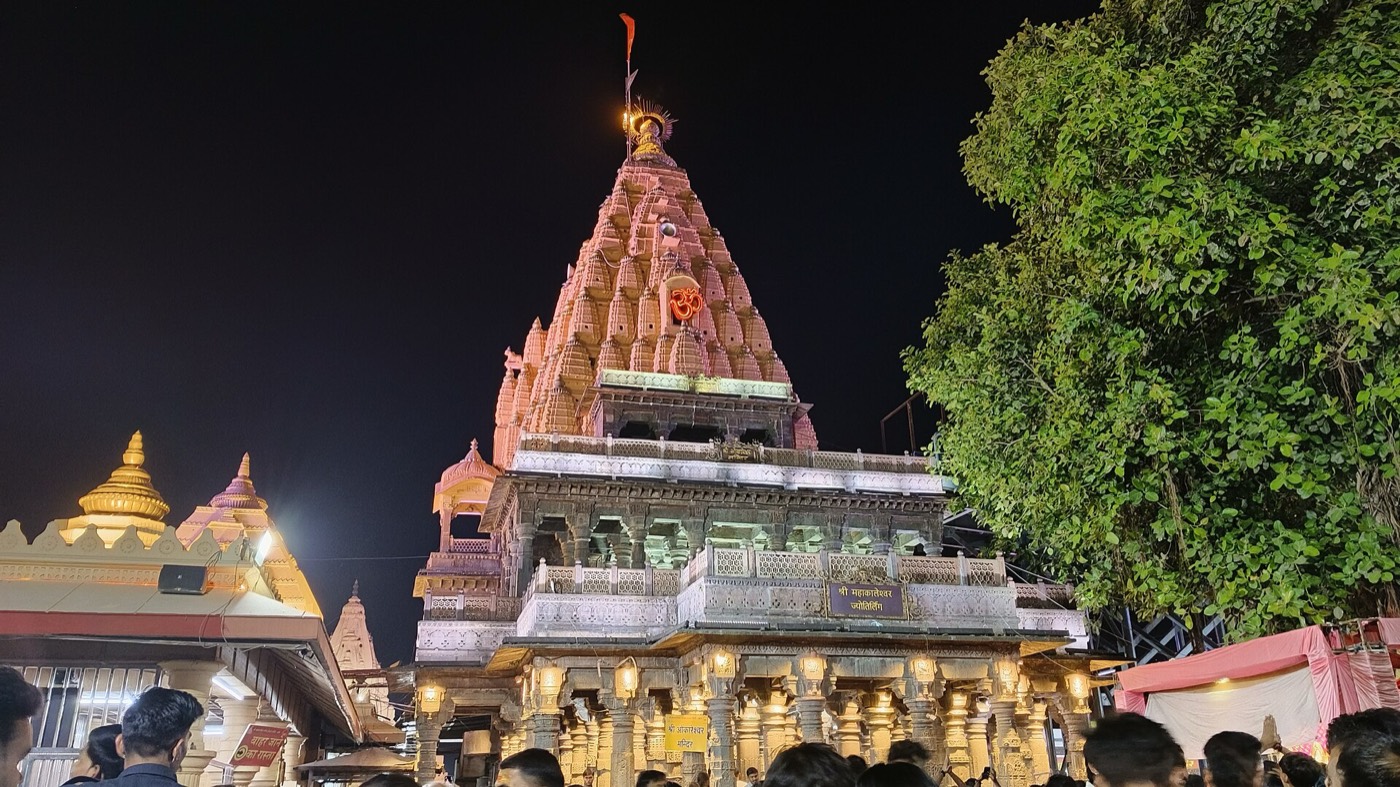
Mahakaleshwar Jyotirlinga, Ujjain
Ujjain, Madhya Pradesh
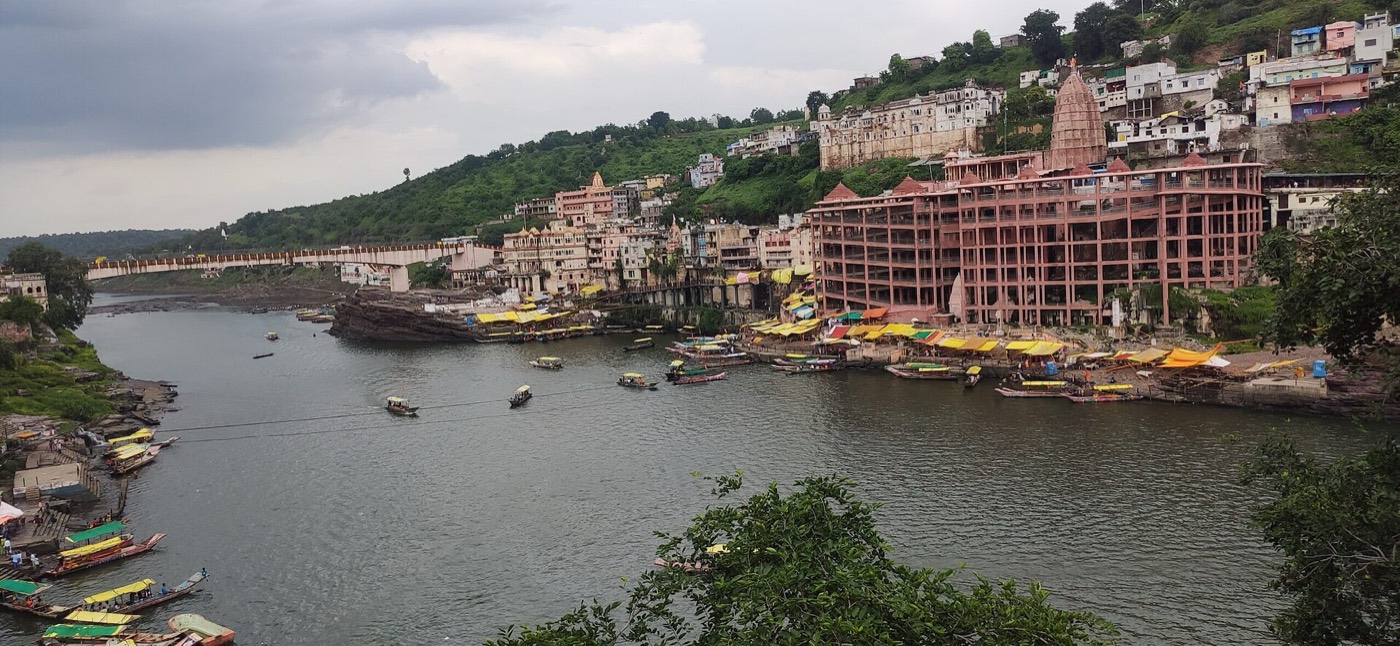
Omkareshwar Jyotirlinga
Khandwa, Madhya Pradesh
Let the Bhasma Aarti set your itinerary
The Bhasma Aarti runs approx 4:00 to 6:00 am daily, and it is the reason many people come to Ujjain at all. Attendance normally requires an advance permit, permits are limited, and demand peaks in Shravan and around Mahashivratri, so treat the booking as the first fixed point of your trip and arrange everything else around the date you secure. Booking rules change from time to time, so verify the current process through the official temple channels rather than an agent's promise.
The aarti also carries the strictest dress code of the whole route. Men wear a dhoti, often bare-chested or with an upper cloth, and women wear a saree or a full salwar suit. Covering the head before the inner sanctum is customary, leather items such as belts and wallets are discouraged inside, and phones, cameras and bags typically go to the cloakrooms. General darshan later in the day is more relaxed, though modest, covered clothing is still expected.
If you cannot get a permit, the trip still works. The temple stays open approx 4:00 am to 11:00 pm, general darshan is free, and the day keeps its own rhythm of aartis: Dadhyodak at approx 7:30 to 8:00 am, Bhog at approx 10:30 to 11:00 am, Sandhya at approx 6:30 to 7:00 pm and Shayan at approx 10:30 to 11:00 pm.
A two-day plan that works
The plan below assumes you arrive through Indore and want the Bhasma Aarti. The shape is simple: reach Ujjain on day one, sleep close to the temple, attend the aarti before dawn on day two, then transfer to Omkareshwar with the whole afternoon and evening ahead of you.
Omkareshwar's darshan pauses twice a day, roughly 12:20 to 1:15 pm for the midday bhog and 4:00 to 4:30 pm for the evening adornment of the linga, so time your arrival for the 1:15 pm or 4:30 pm reopening rather than standing at a shut gate. The evening shringar darshan window runs to 9:30 pm, which leaves room for an unhurried twin darshan even after a morning on the road.
A third day is the honest recommendation if you want the parikrama. The island circuit is approx 7 km, best walked early, and the drive back to Indore is approx 77 km, about 2 to 3 hours.
| Day | Leg | The detail |
|---|---|---|
| Day 1 | Reach Ujjain | From Indore airport it is approx 55 km, about 1 to 1.5 hours by road on NH52; by rail, Ujjain Junction is approx 2 km from the temple, about 10 minutes by auto or e-rickshaw |
| Day 1 evening | Mahakaleshwar darshan | Sandhya Aarti at approx 6:30 to 7:00 pm; sleep within walking distance of the temple |
| Day 2 pre-dawn | Bhasma Aarti | Approx 4:00 to 6:00 am; advance permit usually required, strict traditional dress |
| Day 2 morning | Transfer to Omkareshwar | Approx 140 km by road; aim to arrive for the 1:15 pm reopening after the midday pause |
| Day 2 evening | Omkareshwar and Mamleshwar darshan | Shringar darshan 4:30 to 9:30 pm; Shayan Aarti 9:30 to 10:00 pm |
| Day 3 (optional) | Parikrama and return | Approx 7 km island circuit in the morning, then approx 77 km back to Indore, about 2 to 3 hours |
The island day: twin shrines and the parikrama
On ordinary days the calmest darshan window at Omkareshwar is early morning, 5 to 7 am, straight after the Mangal Aarti that runs 4:30 to 5:00 am and opens the temple for darshan at 5:00 am. The island connects to the mainland by a road bridge and by boats across the Narmada, and a full darshan takes in Mamleshwar on the bank as well as the island shrine.
The parikrama is the part pilgrims underestimate. It is approx 7 km around Mandhata island, past the ghats and the confluence of the Narmada with the mythic Kaveri, and it turns a temple stop into a proper morning. Footwear goes to the stands outside the temple, touching the Shivling is not permitted, and if you have booked darshan online, carry a printed ticket and a valid photo ID.
October to March is the comfortable season for the bridge, the ghats and the circuit. The monsoon swells the Narmada and Shravan fills the town with kanwar and jalabhishek pilgrims, which is atmospheric and crowded in equal measure. April to June is hot.
Trains, flights and the roads between
Indore is the hinge for the two Jyotirlingas, but the rail picture needs care. Ujjain Junction is a well-connected railhead almost at the temple's doorstep. Omkareshwar Road, at Mortakka village, is a small halt approx 12 km from the temple, so for mainline trains you are better served by Khandwa Junction, approx 70 km away, or Indore Junction, approx 77 km away, finishing by bus or taxi.
Maihar is a different corridor altogether. The town sits on the Mumbai-Howrah main line, so many mail and express trains halt at Maihar station, approx 5 km from the hill base, and Satna, the nearest big city and rail junction, is approx 35 to 40 km away. By air it is a long approach: Jabalpur is approx 150 km and Khajuraho approx 130 km, and either means a road transfer of 3 to 4 hours.
| Temple | Nearest railhead | Nearest airport | Core darshan hours |
|---|---|---|---|
| Mahakaleshwar, Ujjain | Ujjain Junction, approx 2 km | Indore, approx 55 km | Approx 4:00 am to 11:00 pm |
| Omkareshwar | Omkareshwar Road (Mortakka), approx 12 km | Indore, approx 83 km | 5:00 am to 9:30 pm, pausing 12:20 to 1:15 pm and 4:00 to 4:30 pm |
| Maihar Sharda | Maihar, approx 5 km from the hill base | Jabalpur approx 150 km or Khajuraho approx 130 km | Approx 5:00 am to 9:00 pm |
When to go: the crowd calendar
October to March is the comfortable window for all three temples, with mild weather for Ujjain's old-city lanes, Omkareshwar's ghats and Maihar's hill. The festival calendar is where the real decision lives, because the same journey can mean a powerful darshan or a queue that eats the day. Lunar festivals move each year, so the table below gives windows, not dates.
Two more things belong on the long-range radar. Nag Panchami, falling in the July to August Shravan window, is the one day a year the Nagchandreshwar shrine above Mahakaleshwar opens, and it draws enormous overnight queues. And Ujjain is one of India's four Kumbh sites: the Simhastha comes every 12 years, with the next major cycle expected around 2028, a period when the whole city operates at a different scale.
| Festival | Window | Where | What happens |
|---|---|---|---|
| Mahashivratri | February to March (Phalguna) | Mahakaleshwar and Omkareshwar | Night-long darshan and the year's peak queues at both Jyotirlingas |
| Shravan Mondays and Sawari | July to August (Shravan) | Mahakaleshwar | The Mahakal Sawari palanquin procession crosses the city every Monday, with extended, crowd-managed hours |
| Nag Panchami | July to August (Shravan) | Mahakaleshwar | The Nagchandreshwar shrine opens for this single day each year |
| Kartik Purnima | November (Kartik full moon) | Omkareshwar | Ghats lined with diyas, ritual bathing and a full-moon fair on the island |
| Narmada Jayanti | January to February (Magha Shukla Saptami) | Omkareshwar | The river's birthday, marked with aarti, lamps and processions on the ghats |
| Sharadiya Navratri | September to October | Maihar Sharda | Nine nights of special puja and a huge mela at the base of Trikut Hill |
| Chaitra Navratri | March to April | Maihar Sharda | The spring Navratri, again drawing lakhs of pilgrims to the hill |
The eastern extension: Maihar Sharda
Maihar Sharda is not a side trip from Ujjain. At approx 500 km it is a deliberate extension for a longer Madhya Pradesh loop, and it makes most sense when you are leaving the state eastwards by train. The shrine of Maa Sharda, goddess of wisdom and a Shakti Peeth, sits on Trikut Hill at approx 367 m, above a small railway town on the Mumbai-Howrah main line.
The ascent is the experience. You climb 1,063 stone steps, which takes most pilgrims 45 to 60 minutes, or you ride the ropeway, which runs roughly 6:30 am to 7:30 pm with a short midday pause. Darshan is free and the temple keeps approx 5:00 am to 9:00 pm hours, with a morning window from 5:00 to 8:00 am and an evening window from 4:00 to 9:00 pm. Local faith holds that the immortal warrior Alha still climbs before dawn to lay the first garland on the idol.
If the Shakti thread pulls you further, Vindhyavasini at Mirzapur is approx 190 km on, another major hill shrine of the Vindhya belt.

Where to sleep, and what this guide leaves out
In Ujjain, stay in the old city within walking distance of the temple. Temple-trust and community dharamshalas such as Mahakal Bhakt Niwas offer rooms and dormitories at roughly 500 to 1,200 rupees a night, and mid-range hotels near the temple run about 1,200 to 2,500 rupees with AC and parking. When Shravan or Mahashivratri fills the town, Indore's larger hotels are the fallback.
Omkareshwar's rooms cluster near the boat ghat and the bridge. Temple-linked accommodation is limited to Shri Ji Vishramalaya, which needs booking roughly 15 days ahead, so most pilgrims use ashrams and dharamshalas such as Gita Bhavan, or budget hotels, booked 2 to 4 weeks ahead for festival dates. Maihar town has basic dharamshalas and guesthouses near the station, with Satna offering the wider mid-range choice.
Two honest gaps: this guide does not cover Indore city, and it does not attempt the full twelve-Jyotirlinga circuit: from Omkareshwar, pilgrims often continue to Grishneshwar beside the Ellora caves, approx 380 km on, or to Trimbakeshwar at the source of the Godavari, approx 350 km away, and both have their own pages on this site.
Frequently asked questions
How far is Omkareshwar from Ujjain and can I do both in one trip?
How do I book the Bhasma Aarti at Mahakaleshwar?
Can I visit Ujjain and Omkareshwar in one day from Indore?
What is the dress code at Mahakaleshwar and Omkareshwar temples?
How many steps does Maihar Sharda temple have and is there a ropeway?
Which railway station is best for Omkareshwar?
Compiled from our verified temple guides and public sources including Shri Omkareshwar Jyotirlinga official website (Rules and schedule) · Ujjain District, Government of Madhya Pradesh (festivals) · Wikipedia: Mahakaleshwar Jyotirlinga · Maa Sharda Mata - District Maihar, Govt of MP. Timings and festival dates shift with the lunar calendar; confirm before you travel.