The temples on this loop are not polished tourist landmarks. They are folk shrines, places whose fame spread on foot and by bus long before any tourism board noticed them. Khatu Shyam in Sikar district venerates Barbarika, the Mahabharata warrior worshipped as Shyam Baba, and Salasar Balaji in Churu holds a rare bearded form of Hanuman. The two sit approx 100 km apart and are paired on almost every Shekhawati pilgrim itinerary, usually as a single long day.
Further west, in Bikaner district, Karni Mata at Deshnoke is the famous rat temple, where the sacred kabas are honoured as reincarnated devotees. To the south, the Brahma temple at Pushkar is one of the very few temples in India dedicated to the creator god. The fifth shrine, Mehandipur Balaji in Dausa district, stands apart both on the map and in character: it is a centre of ritual healing on the Jaipur to Agra side of the state, approx 250 km from Salasar and approx 180 km from Khatu, so it fits into the plan differently from the western four.
A word on the numbers before you plan. None of these temples publishes a single fixed timetable, so every clock time in this guide is approximate and shifts with the season. Distances are road estimates and vary by source, sometimes even between two of our own temple pages. Festival dates follow the lunar calendar and move every year, which is why we give windows rather than dates. Where the data is thin or disputed, we say so plainly rather than smoothing it over.
Five shrines, one thread of folk faith
Khatu Shyam's deity is Barbarika, grandson of Bhima, who offered his own head before the Mahabharata war and was granted worship in Krishna's own name until the end of Kaliyuga. Devotees call him Haare Ka Sahara, the refuge of the defeated, and carry triangular nishan flags into the town. The rush peaks on Ekadashi and on Fridays and Saturdays, and swells enormously during the Phalgun mela, when vehicles are stopped well outside town and pilgrims walk the final stretch.
Salasar Balaji holds a self-manifest idol of Hanuman with a full beard and moustache, a form found almost nowhere else in India. Tradition dates the temple to Vikram Samvat 1811, around 1754 CE, when the idol was unearthed from a farmer's field. The signature offering is bajra churma, and sponsored sawamani offerings run through the day on booking. Red pennant flags tied by devotees are the shrine's emblem, and Tuesdays and Saturdays, sacred to Hanuman, are its heaviest days.
Karni Mata was a warrior-sage of the fourteenth to sixteenth century, revered as an incarnation of Durga, and her Deshnoke temple is a Charan-Rajput kuldevi shrine completed in its present marble form in the early twentieth century under Maharaja Ganga Singh of Bikaner. Its fame rests on the kabas, the sacred rats, commonly reported at approx 25,000, among which pilgrims walk barefoot. Sighting one of the rare white kabas is counted as a direct blessing from the goddess.
Mehandipur Balaji venerates the child form of Hanuman alongside Pretraj Sarkar, the judge of spirits, and Bhairav the Kotwal. It is a well-known centre of ritual healing and exorcism, and its pilgrims include the sankatwale, people believed to be under spirit affliction, alongside ordinary devotees seeking blessings. Its etiquette is unlike any other temple in this guide, so we cover it separately below rather than treating it as one more stop.
The Jagatpita Brahma Mandir at Pushkar, with its red spire and marble sanctum, is one of the very few temples in India dedicated to Brahma, and its core shrine dates to the fourteenth century. It stands a short walk from Pushkar lake and its bathing ghats, through the old bazaar. One custom surprises visitors: by long tradition, married householders do not enter the innermost sanctum, and instead hand their offering to the priest, who presents it on their behalf.
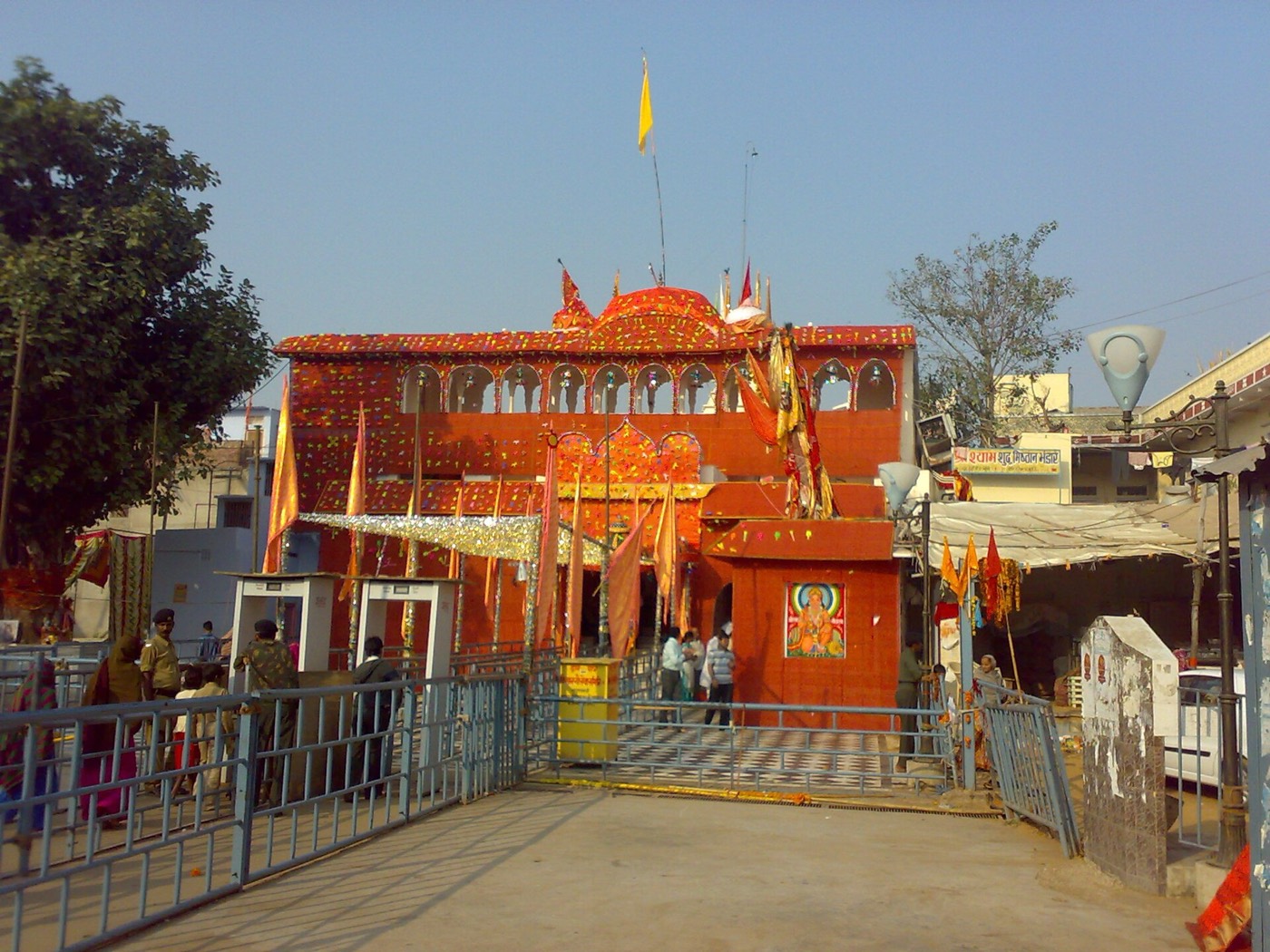
Khatu Shyam Ji Temple
Sikar, Rajasthan

Salasar Balaji
Churu, Rajasthan

Karni Mata Temple (Rat Temple), Deshnoke
Bikaner, Rajasthan
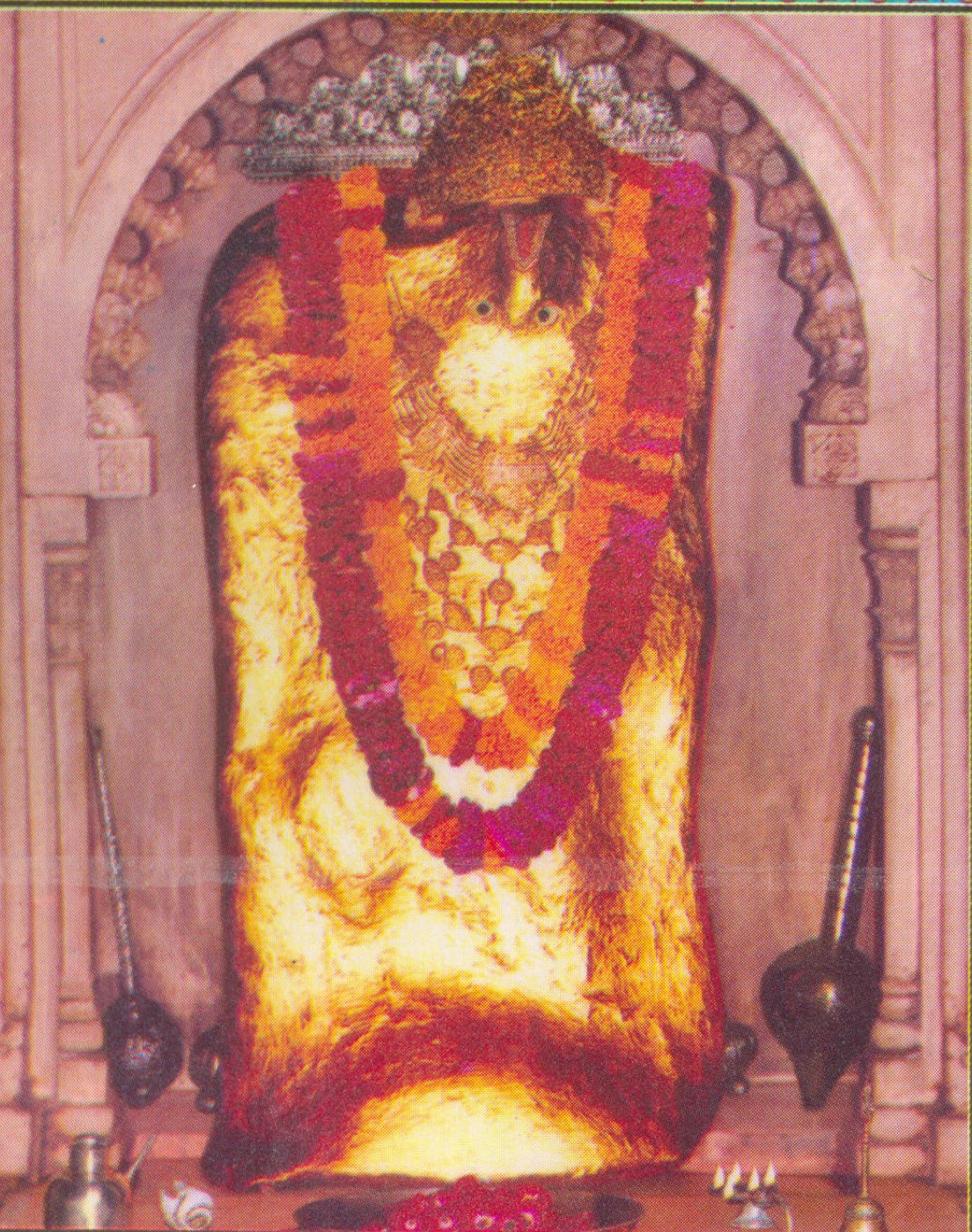
Mehandipur Balaji Temple
Dausa, Rajasthan
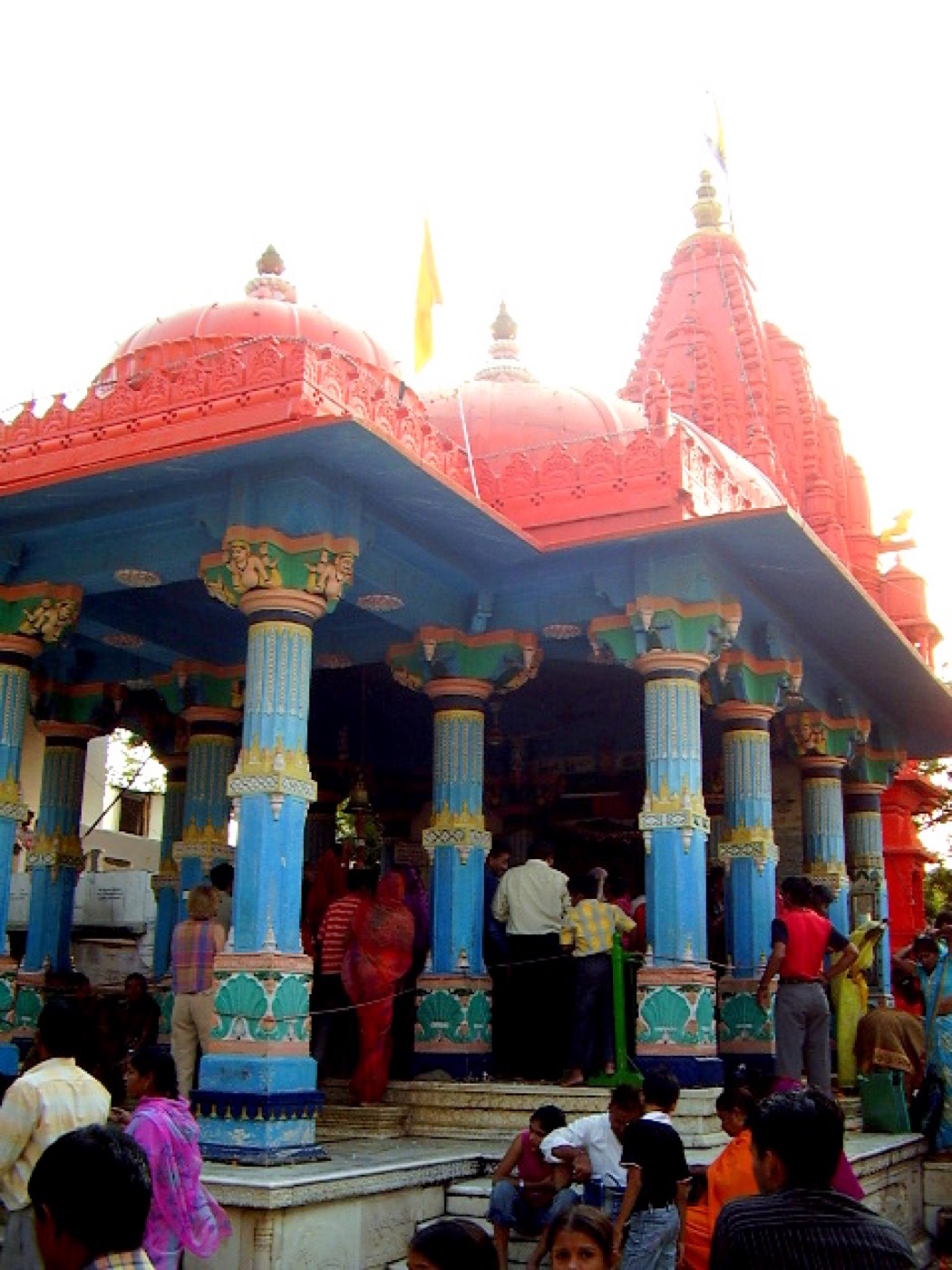
Brahma Temple, Pushkar
Ajmer, Rajasthan
The circuit at a glance
The table below is the circuit in one view. Two patterns matter for planning. First, the two shrines with hard midday breaks, Khatu Shyam and the Brahma temple, punish a badly timed arrival, while Karni Mata and Salasar run through the day with only brief aarti pauses. Second, every stop has a workable railhead, but the road is what really connects them, and Jaipur is the natural hinge of the whole loop. All times and distances are approximate and shift with the season.
| Stop | District | Typical darshan window (approx) | Midday break | Nearest railhead (approx) |
|---|---|---|---|---|
| Khatu Shyam | Sikar | 4:30 AM to 10:00 PM summer; 5:30 AM to 9:00 PM winter | Yes, approx 12:30 to 4:00 PM summer, 1:00 to 5:00 PM winter | Ringas Junction, approx 17 km |
| Salasar Balaji | Churu | approx 5:00 AM to 10:00 PM | No, brief curtain pauses at aartis only | Sujangarh, approx 24 to 30 km |
| Karni Mata, Deshnoke | Bikaner | approx 4:00 AM to 10:00 PM | No, open through the day | Deshnoke approx 1 km (limited halts); Bikaner Junction approx 30 km |
| Mehandipur Balaji | Dausa | approx 6:00 AM to 10:00 PM | Unconfirmed; aartis approx 6:00 AM and 6:30 PM | Bandikui Junction, approx 40 to 42 km |
| Brahma Temple, Pushkar | Ajmer | approx 6:30 AM to 8:30 PM winter; 6:00 AM to 9:00 PM summer | Yes, approx 1:30 to 3:00 PM | Ajmer Junction, approx 14 km |
A three to four day route plan
Day one runs Jaipur to Khatu to Salasar. Leave Jaipur early: the drive to Khatu is approx 80 km and takes about 2 hours via NH-52, with the turn-off near Reengus. Aim to finish darshan before the midday break, which begins approx 12:30 PM in summer and approx 1:00 PM in winter. From Khatu it is approx 100 km to Salasar, where the sandhya aarti after sunset closes the day well. Sleep in Salasar, where dharamshala beds are plentiful and cheap.
Day two crosses into the desert. Catch the mangla aarti at Salasar, held between approx 5:00 and 6:00 AM, then drive to Deshnoke. Our two temple pages give different estimates for this leg, approx 140 km by one and approx 165 km by the other, so budget for the longer figure. Karni Mata keeps no midday closure, which makes an afternoon arrival workable. Take your time among the kabas, then head into Bikaner, approx 30 km north and roughly 40 to 50 minutes away, for the night.
Day three is the long haul from Deshnoke to Pushkar, approx 245 km, the biggest single leg of the loop. Start early so you arrive with the evening free. The Brahma temple rests approx 1:30 to 3:00 PM and closes for the night at approx 8:30 PM in winter and approx 9:00 PM in summer. Its sandhya aarti, timed roughly 40 minutes after sunset, is the most atmospheric moment of the day for a visitor, and the lake ghats are at their best in the same hour.
Day four returns to Jaipur, approx 145 km and about 3 hours via NH 48 and Kishangarh. If you can add a day, spend it on Mehandipur Balaji as an out-and-back from Jaipur, approx 100 to 110 km each way and roughly 2.5 to 3 hours of driving in each direction. Travellers routing through the capital often add Govind Dev Ji, the Krishna shrine in the City Palace complex, as a gentle final darshan before the journey home.
| Leg | Road distance (approx) | Planning note |
|---|---|---|
| Jaipur to Khatu Shyam | approx 80 km, about 2 hours | Via NH-52 towards Sikar, turn-off near Reengus |
| Khatu Shyam to Salasar Balaji | approx 100 km | The classic Shekhawati pairing, usually done in one day |
| Salasar Balaji to Karni Mata, Deshnoke | approx 140 to 165 km | Sources differ on this leg; budget for the longer figure |
| Deshnoke to Bikaner | approx 30 km | Roughly 40 to 50 minutes; most travellers sleep in Bikaner |
| Deshnoke to Pushkar | approx 245 km | The longest leg of the loop; start early |
| Pushkar to Jaipur | approx 145 km | About 3 hours via NH 48 and Kishangarh |
| Jaipur to Mehandipur Balaji | approx 100 to 110 km | Roughly 2.5 to 3 hours on the Jaipur to Agra corridor; best as its own day |
Where Mehandipur fits, and how to visit it respectfully
Mehandipur Balaji is not a sightseeing stop, and it is fair to say so plainly. Alongside ordinary darshan, the temple is known for rituals intended to relieve the sankatwale, and the atmosphere around the evening aarti at approx 6:30 PM can be charged and, for some visitors, distressing. Whatever you make of the tradition, you are a guest in it, and the local customs are strict and specific. Follow them exactly.
The rules that matter most, drawn from local ritual custom, are these:
- Do not carry prasad home; buy only what you will offer or eat on the spot
- Do not accept, eat or share food or prasad with anyone else at the temple
- After darshan, leave and head straight home without looking back or stopping to eat, per local custom
- Keep sweets, perfume and strongly fragrant items out of the temple
- Never film, photograph or stare at afflicted pilgrims during rituals; photography inside the sanctum is restricted
- Tuesdays and Saturdays are the ritual-heavy days; choose a weekday for a calmer darshan
Fairs and festival windows
The circuit's great fairs cluster in two lunar seasons. In late winter and spring, Khatu's Phalgun Lakkhi Mela runs roughly Pratipada to Dwadashi in the Phalgun month, February or March, ending about 8 to 9 days before Holi. Then Chaitra, falling in March or April, brings Salasar's Chaitra Purnima fair, Karni Mata's spring Navratri fair and Hanuman Jayanti at Mehandipur, all within weeks of each other. In autumn, the Ashwin season fills Salasar and Deshnoke again, and Kartik Purnima, in October or November, gives Pushkar its biggest week of the year, when the camel fair and the sacred bathing day coincide.
These are lunar dates, so they move every year, and we give windows rather than fixed days on principle. Treat a fair week as a decision point rather than a bonus: the circuit at festival time is vivid and extremely crowded, with rooms booked out well ahead and vehicles held far outside Khatu during the mela. If you want calm darshan, check the lunar calendar for your travel month and steer around these windows. Weekly rhythms matter too. Ekadashi plus Fridays and Saturdays are the heavy days at Khatu, while Tuesdays and Saturdays are the heavy days at Salasar and Mehandipur.
| Festival | Temple | Usual window | What to expect |
|---|---|---|---|
| Phalgun Lakkhi Mela | Khatu Shyam | Phalgun month, Feb-Mar, roughly Pratipada to Dwadashi, ending about 8 to 9 days before Holi | The circuit's biggest gathering; vehicles stopped outside town, long walks in |
| Monthly Shyam Ekadashi | Khatu Shyam | Every Shukla Ekadashi, year round | A mini-festival each fortnight with swelling queues |
| Chaitra Purnima Mela | Salasar Balaji | Mar-Apr, Chaitra full moon | Peak fair for Hanuman Jayanti; near round-the-clock darshan |
| Ashwin Purnima Mela | Salasar Balaji | Sep-Oct, Ashwin full moon | The second great annual fair; dharamshalas fill up |
| Chaitra Navratri Fair | Karni Mata, Deshnoke | Mar-Apr, Chaitra Shukla Ekam to Dashmi | The larger of the temple's two fairs; pilgrims arrive on foot |
| Ashwin Navratri Fair | Karni Mata, Deshnoke | Sep-Oct, Ashwin Navratri | Slightly smaller autumn fair, equally sacred |
| Hanuman Jayanti | Mehandipur Balaji | Chaitra Purnima, Mar-Apr | The temple's principal festival; pre-dawn to late-night darshan |
| Kartik Purnima and Pushkar Fair | Brahma Temple, Pushkar | Oct-Nov, the week ending on the Kartik full moon | Heaviest footfall of the year; dawn dips in the lake and the camel fair together |
Where to sleep on the circuit
Khatu and Salasar are both towns built around their pilgrims, so beds are plentiful and cheap. Khatu has a dense belt of dharamshalas, budget lodges and mid-range hotels within walking distance of the temple, with more guesthouses at Ringas; for comfort, most travellers base in Sikar, approx 45 km away, or Jaipur, approx 80 km. During the Phalgun mela, Khatu's rooms fill months ahead and many pilgrims sleep in tented camps, so either book very early or plan to arrive and leave the same day. Salasar's dharamshalas and trust-run guest houses often offer basic free or donation-based rooms, with larger hotels in Sujangarh and Sikar.
Deshnoke itself has only basic dharamshalas and simple guest houses, enough for a night if you want the early mangla aarti; most visitors stay in Bikaner, approx 30 km away, which runs from budget hotels near the junction to heritage properties such as Lallgarh Palace and Laxmi Niwas. Pushkar is the easiest overnight stop of the circuit, with everything from guesthouses around the ghats to mid-range lakeside hotels, and a large tent city during the fair, when rooms are booked out weeks ahead; Ajmer, approx 14 km away, is the overflow. Mehandipur is thick with inexpensive dharamshalas and long-stay lodges, with better hotels in Dausa, approx 50 km, or Jaipur, approx 110 km.
What this guide does not settle
Entry first. General darshan is free at all five temples. At Khatu Shyam, several sources report a paid priority slot of approx Rs 100, while others say the committee sells no such ticket at all. We could not settle it, so treat the paid tier as unverified and plan as if it does not exist. Timings are the other soft ground: none of these shrines publishes one fixed official timetable, and hours stretch on fair days, so reconfirm with the temple trusts or locally on the day, especially around Ekadashi at Khatu and Navratri at Deshnoke.
This guide also leaves out shrines that many pilgrims fold into the same journey. Jeen Mata near Sikar, the Rani Sati temple at Jhunjhunu and Khole ke Hanuman in Jaipur are all commonly added to a Shekhawati circuit, but we do not yet have verified pages for them, so we name them here without details rather than guess. Finally, the road distances between stops differ between sources, sometimes by approx 25 km on a single leg, which is why every figure in this guide carries the word approx and why the longer estimate is the safer one to plan around.
Frequently asked questions
Can Khatu Shyam and Salasar Balaji be done in one day from Jaipur?
How many days do you need for the Rajasthan temple circuit?
Is there an entry fee at Khatu Shyam, Salasar Balaji or Karni Mata?
What are the rules at Mehandipur Balaji temple?
Which railway stations serve the Rajasthan temple circuit?
What is the best time of year for the Khatu Shyam and Salasar circuit?
Compiled from our verified temple guides and public sources including Rajasthan Tourism: Khatu Shyam Ji Mandir · Wikipedia: Salasar Balaji · Wikipedia: Karni Mata Temple (Deshnoke) · Wikipedia: Mehandipur Balaji Temple · Wikipedia: Brahma Temple, Pushkar. Timings and festival dates shift with the lunar calendar; confirm before you travel.