Rajasthan's pilgrimage map has a curious shape. Its most heavily visited shrines are not in the big tourist cities but in small towns scattered across the Shekhawati and Dausa countryside, and Jaipur happens to sit within striking distance of three of them. Khatu Shyam now draws some of the largest pilgrim crowds in north India. Mehandipur Balaji is unlike any other Hanuman temple in the country, a place of ritual healing with rules all its own. Salasar Balaji enshrines a bearded, moustached Hanuman that millions of pilgrims, many carrying red flags, walk to every year.
The fourth temple needs no drive at all. Govind Dev Ji, the family deity of the Kachhwaha royal house, sits in the Jai Niwas garden just north of the City Palace, and its unusual rhythm of seven timed unveilings shapes the old city's whole day. Base yourself inside the walls and you can attend the pre-dawn Mangla jhanki, spend the middle of the day among the forts and palaces, and be back for the evening aarti.
The planning problem is not distance, it is timing. Each of these temples has its own crowd calendar: Ekadashi plus Fridays and Saturdays at Khatu, Tuesdays and Saturdays at the two Balaji shrines, and the great lunar fairs, when rooms fill and vehicles are stopped outside town. This guide gives you the road facts for each trip, a comparison of all four, and the honest caveat that runs through everything: clock times here are approximate, because these temples adjust their hours by season and festival, and the fair dates move with the lunar calendar.
Why Jaipur works as a darshan base
Jaipur earns its place on connections alone. Jaipur Junction is the state's busiest railway station, with direct trains from Delhi, Agra, Ahmedabad and Mumbai, and it sits approx 4 km from the walled city. Jaipur International Airport at Sanganer is approx 13 km out, roughly 30 to 45 minutes by cab. If you are driving from Delhi, the run via NH48 is approx 280 km and takes around 5 to 6 hours.
The second advantage is stay. The old city around Badi Chaupar, Hawa Mahal and Chandpole has everything from simple dharamshalas to mid-range hotels within walking distance of Govind Dev Ji, while MI Road, Bani Park and the station area add plenty of choice a short ride away. Book ahead for Janmashtami, when rooms near the old city fill fast.
The third advantage is reach. All three of the big out-of-town shrines can be done as day trips, though they pull in different directions: Khatu and Salasar lie towards Shekhawati on the Sikar side, while Mehandipur sits east on the Agra side. That geography decides your pairings, and we come back to it below.
The four temples at a glance
Here is the whole guide in one table. Distances are approximate road figures and vary with your starting point in Jaipur, and drive times assume normal traffic. Busiest days are the ones to avoid unless the crowd is the point.
| Temple | Deity | From Jaipur | Drive time | Busiest days |
|---|---|---|---|---|
| Govind Dev Ji | Govind Dev Ji (Krishna) with Radha | In the walled city | Walk from Badi Chaupar | Janmashtami and Krishna festival days |
| Khatu Shyam Ji | Khatu Shyam (Barbarika) | approx 80 km | about 2 hours | Ekadashi, Fridays and Saturdays, Phalgun Mela |
| Mehandipur Balaji | Balaji, the child form of Hanuman | approx 100 to 110 km | roughly 2.5 to 3 hours | Tuesdays, Saturdays, Hanuman Jayanti |
| Salasar Balaji | Bearded Hanuman (Balaji) | approx 170 km | roughly 3.5 to 4 hours | Tuesdays, Saturdays, Chaitra and Ashwin melas |
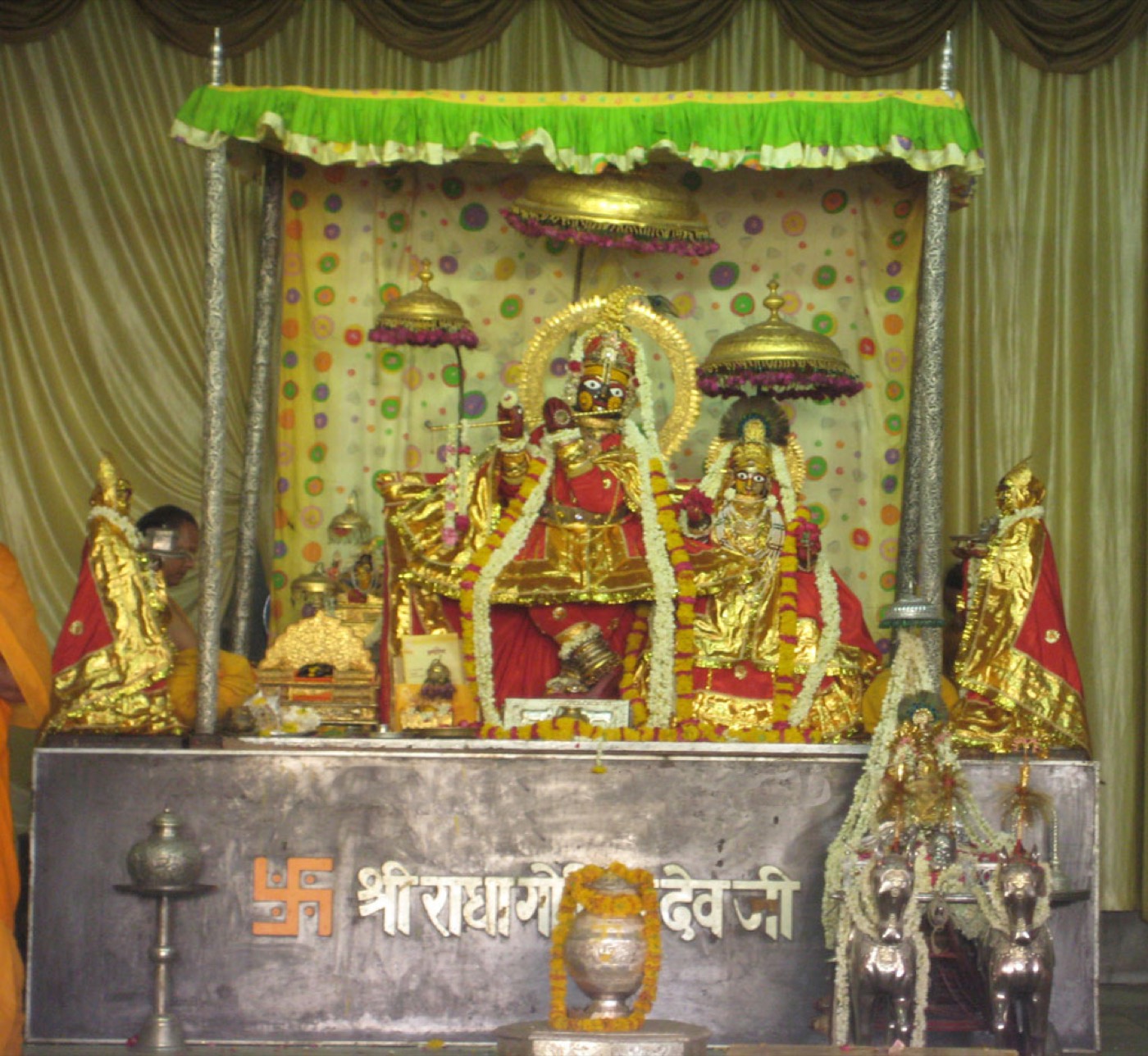
Govind Dev Ji Temple, Jaipur
Jaipur, Rajasthan
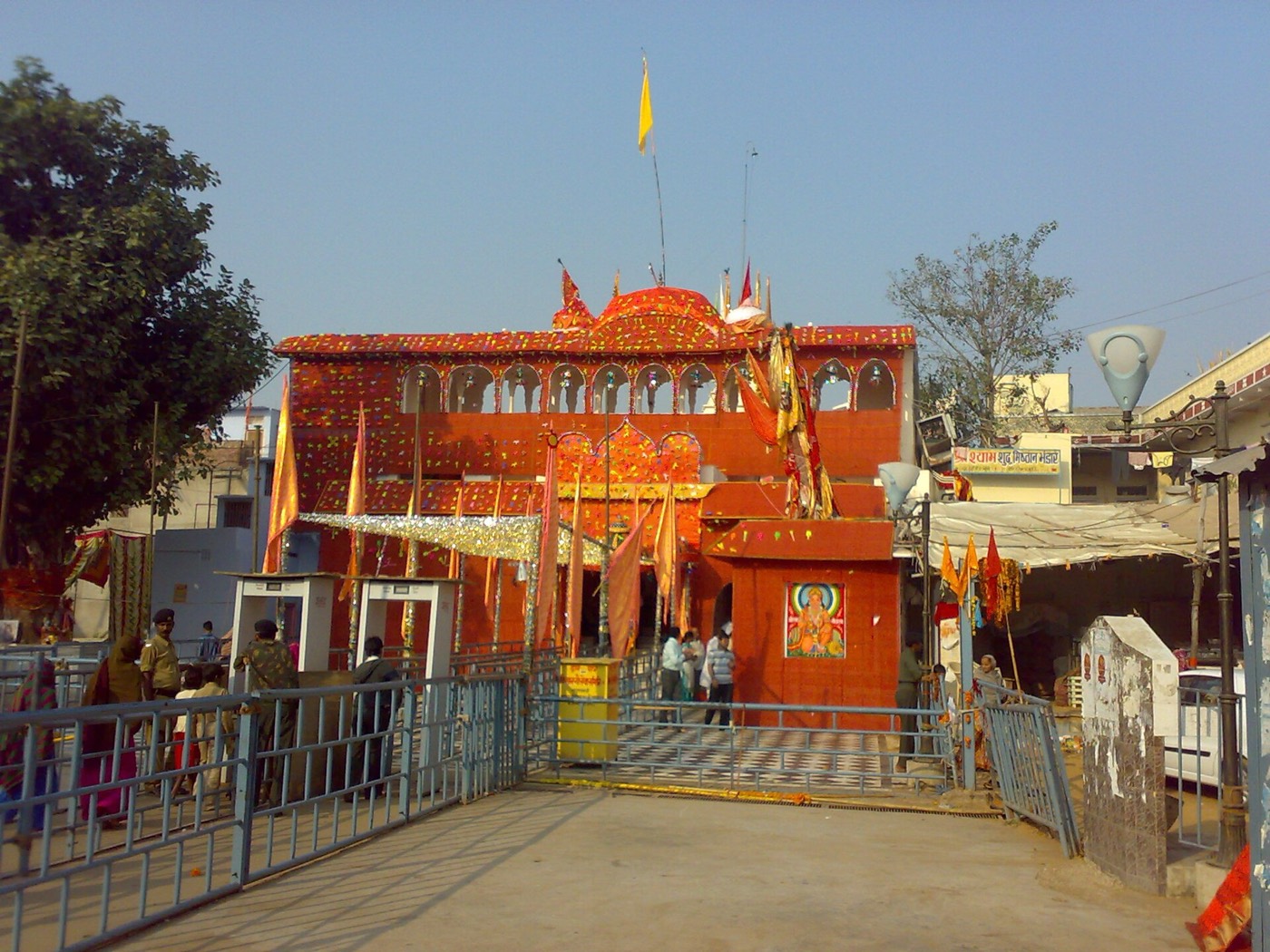
Khatu Shyam Ji Temple
Sikar, Rajasthan
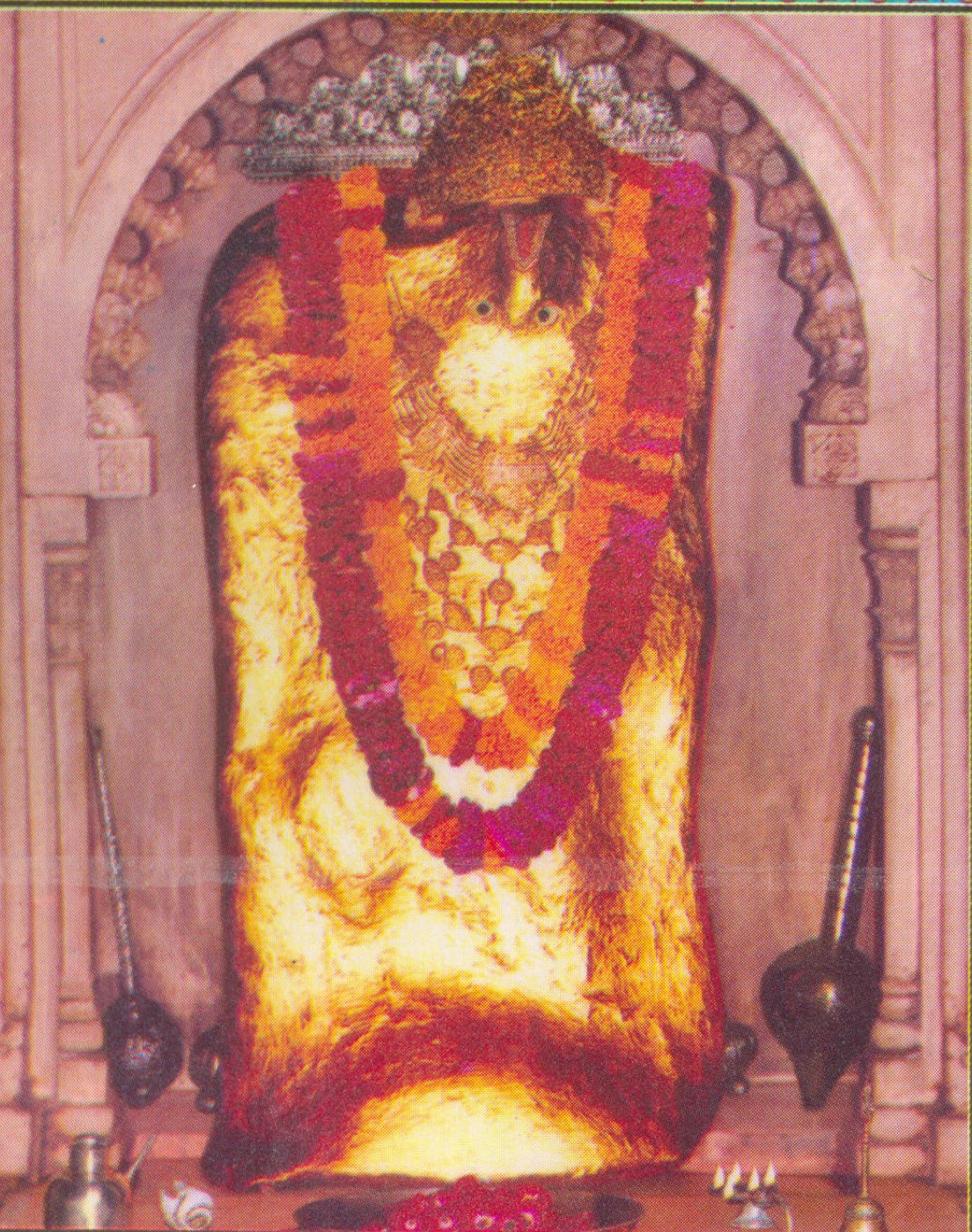
Mehandipur Balaji Temple
Dausa, Rajasthan

Salasar Balaji
Churu, Rajasthan
Govind Dev Ji, the temple you walk to
Govind Dev Ji does not run like most temples. The deity is unveiled only in seven timed jhankis between approx 5:00 AM and 8:15 PM, with the curtain drawn between each one and a long midday close from approx 11:45 AM to 5:00 PM. There is no continuous darshan; you plan around a specific jhanki. Mangla, the pre-dawn unveiling at approx 5:00 to 5:15 AM, and the evening Sandhya aarti at approx 5:45 to 6:45 PM draw the largest gatherings.
This is the family shrine of Jaipur's Kachhwaha rulers, built by Maharaja Sawai Jai Singh II in the early 18th century, and the idol was brought from Vrindavan, the town of Banke Bihari, for safekeeping. There is no soaring tower, just a broad open hall in the Jai Niwas garden where thousands gather for each unveiling. Entry is free, with no ticket of any kind.
Practicalities are simple. The old-city lanes are narrow, so park near Badi Chaupar or Hawa Mahal and walk in. Photography is generally not allowed inside the sanctum, security checks are routine, and the jhanki window is short, so keep the darshan line moving. On Janmashtami the timings are revised for the day and the crowds are enormous.
Khatu Shyam: plan around Ekadashi
The drive is the easy part: approx 80 km from Jaipur, about 2 hours via NH-52 towards Sikar with a turn-off near Reengus. Without a car, take a Sikar-bound bus and change for Khatu, or ride the Jaipur-Sikar rail line to Ringas Junction, approx 17 km from the temple, where shared jeeps and taxis wait outside the station.
The hard part is the calendar. Khatu Shyam is the shrine of Barbarika, the Mahabharata warrior blessed by Krishna to be worshipped in his own name, and his tie to Ekadashi makes every Shukla Ekadashi a mini-festival with swelling queues and full aarti cycles. Fridays and Saturdays run heavy through the year as well. The peak of peaks is the Phalgun Lakkhi Mela in February or early March, roughly 12 days ending about 8 to 9 days before Holi, when lakhs of pilgrims walk in carrying nishan flags, vehicles are stopped well outside town, and everyone covers the final stretch on foot.
Timings split by season and include a genuine midday break. In summer the darshan windows run approx 5:00 AM to 12:30 PM and 4:00 to 10:00 PM; in winter, approx 6:00 AM to 1:00 PM and 5:00 to 9:00 PM. On Ekadashi and festival days the break is often waived and the hours stretch, at the price of very long queues. General darshan is free. Several sources report a paid priority slot at approx Rs 100, others say no such ticket exists, so plan on the ordinary line.
Mehandipur Balaji: read the rules first
Mehandipur Balaji is not a sightseeing stop, and it helps to know that before you go. Alongside ordinary devotees, the temple receives the sankatwale, people believed to be under spirit affliction, who come for its well-known exorcism rituals before Balaji, Pretraj Sarkar and Bhairav. The atmosphere, especially around the evening aarti at approx 6:30 PM, can be intense, and visitors who are pregnant, unwell or travelling with young children should weigh whether they want to be present for it.
The etiquette is stricter than anywhere else in this guide. Do not carry sweets, perfume or strongly fragrant items inside. Buy only as much prasad as you will offer or eat on the spot, never carry it home, and do not accept or share food with anyone in Mehandipur. Local custom says that after darshan you leave for home without looking back or stopping to eat. Do not film, photograph or stare at afflicted pilgrims; the sanctum restricts photography in any case.
Getting there is straightforward: approx 100 to 110 km from Jaipur, roughly 2.5 to 3 hours on the Jaipur-Agra corridor, with regular state and private buses that often drop at the Balaji Mode junction near Mahwa for a short onward hop. The nearest railhead is Bandikui Junction at approx 40 to 42 km. The temple runs approx 6:00 AM to 10:00 PM, anchored by aartis at approx 6:00 AM and 6:30 PM, and Tuesdays and Saturdays are the ritual-heavy peak days. A plain weekday visit is noticeably calmer.
Salasar Balaji: the long Shekhawati haul
Salasar is the farthest of the three: approx 170 km from Jaipur, roughly 3.5 to 4 hours by car via Sikar, with direct pilgrim buses running daily. It works as a day trip, but a long one, and many travellers make it an overnight instead. The nearest railhead is Sujangarh at approx 24 to 30 km, while Sikar Junction, approx 55 to 60 km away, is the larger station with more trains.
What waits at the end of the road is a Hanuman unlike any other in India: a self-manifest idol with a full beard and moustache, unearthed from a farmer's field and enshrined, by traditional account, in Vikram Samvat 1811, around 1754 CE. The signature offering is bajra churma, and devotees sponsor sawamani offerings of churma and laddus through the day. Red pennant flags are carried in and tied by pilgrims. The temple stays open long hours, approx 5:00 AM to 10:00 PM, drawing the curtain only briefly for the mangla, bhog and shayan aartis.
Season matters here more than at the others. Shekhawati summers, April to June, are very hot and dusty, and the two great fairs, on the Chaitra full moon in March or April and the Ashwin full moon in September or October, run the town near round the clock with rooms booked out well ahead. October to March is the comfortable window, and Tuesdays and Saturdays are the big weekly days.
Road legs and sensible pairings
Khatu and Salasar pair naturally. They are approx 100 km apart on the same Shekhawati pilgrim circuit, which is why so many travellers do them as one loop with a night in Khatu, Sikar or Salasar. Mehandipur points the other way entirely, east towards Agra, at approx 180 km from Khatu and approx 250 km from Salasar, so treat it as its own trip rather than a bolt-on.
If you have an extra day, the Brahma Temple at Pushkar, one of the rare temples to Brahma anywhere, is approx 145 km from Jaipur via Ajmer, which itself is approx 130 km down the highway. And from Salasar, the desert road towards Bikaner brings Karni Mata at Deshnoke within reach at approx 140 km.
| From | To | Distance | Notes |
|---|---|---|---|
| Jaipur | Khatu Shyam Ji | approx 80 km | about 2 hours via NH-52, turn-off near Reengus |
| Jaipur | Mehandipur Balaji | approx 100 to 110 km | roughly 2.5 to 3 hours on the Jaipur-Agra corridor |
| Jaipur | Salasar Balaji | approx 170 km | roughly 3.5 to 4 hours via Sikar |
| Khatu Shyam Ji | Salasar Balaji | approx 100 km | the classic Shekhawati pairing |
| Mehandipur Balaji | Khatu Shyam Ji | approx 180 km | opposite sides of Jaipur, hard to combine |
| Mehandipur Balaji | Salasar Balaji | approx 250 km | too far to pair in a single day |
| Jaipur | Brahma Temple, Pushkar | approx 145 km | via Ajmer, approx 130 km |
| Salasar Balaji | Karni Mata, Deshnoke | approx 140 km | desert-side add-on towards Bikaner |
When to go, when to stay away
October to March is the comfortable season for the whole cluster. The harder question is whether you want the festivals. They are the temples at their fullest in both senses: the richest darshan of the year and the heaviest crowds, with timings revised, midday breaks waived and rooms gone.
One honesty note on dates. Every festival below follows the lunar calendar, so it lands in a window rather than on a fixed date, and the civil dates shift each year. Check the current panchang or the temple's own announcements before locking travel.
| Temple | Window | What happens |
|---|---|---|
| Govind Dev Ji | Janmashtami, August or September | The biggest night of the year, with midnight celebrations and revised timings |
| Govind Dev Ji | Holi and Phalgun, March | Braj-style colour and flower celebrations for Krishna |
| Khatu Shyam Ji | Phalgun Mela, February or early March | About 12 days ending 8 to 9 days before Holi; lakhs walk in with flags |
| Khatu Shyam Ji | Shukla Ekadashi, year round | Mini-festival queues and full aarti cycles |
| Mehandipur Balaji | Hanuman Jayanti, March or April | The principal fair, with pre-dawn to late-night darshan |
| Mehandipur Balaji | Tuesdays and Saturdays, weekly | The ritual-heavy days, with dense queues |
| Salasar Balaji | Chaitra Purnima, March or April | Hanuman Jayanti fair; pilgrims walk in with red flags |
| Salasar Balaji | Ashwin Purnima, September or October | The second great fair; the town runs near round the clock |
Where to stay, and what this guide leaves out
For the city, stay inside or beside the walled old city if Govind Dev Ji is your anchor. Khatu has a dense belt of dharamshalas and lodges within walking distance of the temple, with Sikar, approx 45 km away, as the comfortable fallback; during the Phalgun Mela rooms fill months ahead and many pilgrims sleep in tented camps or simply arrive and leave the same day. Mehandipur is thick with dharamshalas and inexpensive long-stay rooms, though facilities are basic, and the better hotels are in Dausa, approx 50 km away. Salasar is built for pilgrims, with plentiful cheap and donation-based rooms that vanish during the two fairs.
And the gap: Jaipur devotees will notice that Khole ke Hanuman Ji, a much-loved Hanuman shrine in Jaipur, is not covered here. We do not yet have a verified page for it, so we name it here and leave it for a future update. In the same spirit, every figure above is approximate by design. These temples publish few fixed timetables, hours shift with season and festival, and the honest move is to confirm timings on the day you travel.
Frequently asked questions
Which temple near Jaipur is best for a one day trip?
How do I reach Khatu Shyam from Jaipur without a car?
Which days should I avoid at Khatu Shyam because of crowds?
Can I visit Khatu Shyam and Salasar Balaji in one day from Jaipur?
What are the rules at Mehandipur Balaji for prasad and food?
What are Govind Dev Ji temple timings in Jaipur?
Compiled from our verified temple guides and public sources including Wikipedia: Govind Dev Ji Temple · Rajasthan Tourism: Khatu Shyam Ji Mandir · Wikipedia: Mehandipur Balaji Temple · Wikipedia: Salasar Balaji. Timings and festival dates shift with the lunar calendar; confirm before you travel.